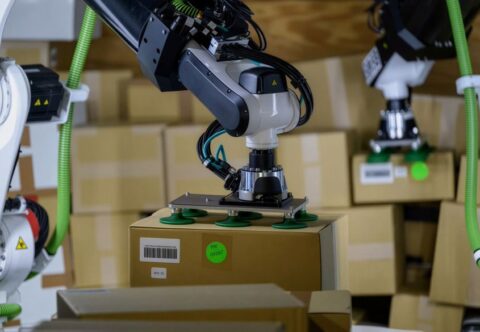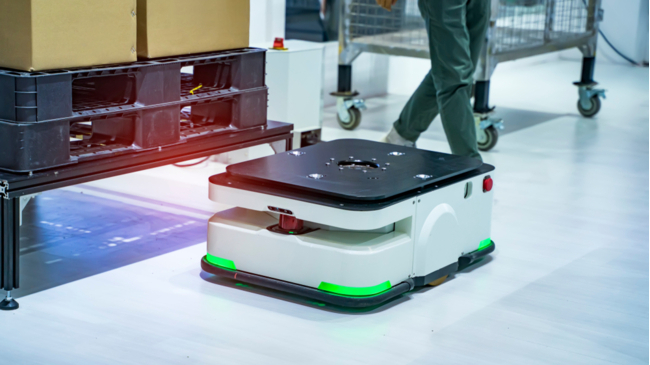
Robotisation leads to a change in tasks of warehouse workers. With this, the workload also changes. The work can become lighter, but in some respects also heavier, both physically and cognitively. TKI Dinalog investigated the consequences of robotisation for warehouse staff. It took a close look at specific robot forms, from goods-to-person systems to collaborative robots (cobots).
How do you take human capital into account when robotising? For the project 'Man and Robot in the Warehouse', TKI Dinalog spoke to several companies, managers and employees about their experiences during the robotisation process. Some of the observations:
Goods-to-person systems
Companies deploy goods-to-person systems mainly to increase productivity. Labour market tightness and reducing heavy work were also mentioned as arguments. In addition, certain systems (such as Autostore) would make more efficient use of the cubic metres in a warehouse. TKI Dinalog investigated at several organisations what impact this system had on order pickers. Conclusion: goods-to-person systems offer both opportunities and threats.
At companies the researchers spoke to, such as Boston Scientific and Bausch Health, goods-to-person systems came alongside existing order picking systems. This created more opportunities for task rotation. Workers could be assigned to different logistics tasks. An expansion of the number of possible tasks offered them opportunities for learning.
Many companies called the work for order pickers "more ergonomic" thanks to goods-to-person systems. Because employees have to walk less, they get less tired. TKI Dinalog cautions against this. With goods-to-person systems, the picking frequency is higher than in traditional order picking processes. With heavier products, this can increase the load. Indeed, walking can be tiring, but is rarely unhealthy. "Replacing it with place-based order picking workstations is almost always unhealthier, especially with less ergonomic workstations," concludes TKI Dinalog.
There are also social implications. Workstations are generally at some distance from each other. As a result, they can make social contacts while working difficult, even though the social aspect of work has a significant impact on job satisfaction. "Given the importance of creating an attractive working environment, these aspects therefore deserve attention in design processes."
Also read: 'Consider humans when robotisation'
The cobot as colleague
Cobots would still be in the experimental phase. Companies TKI Dinalog spoke to indicated that it was not out of necessity but more out of curiosity that they wanted to gain experience with cobots. The lack of flexibility of cobots proved a stumbling block. Fruit and vegetable company The Greenery wanted to use a cobot on an 'on-call' basis to pack orders during busy periods. At Chain Logistics, the aim was to deploy the cobot on value-adding tasks, in this case gluing and pressing tasks. It turned out that the robot could only partially take over these tasks due to deviating product sizes. This made the payback period too long. At a company in the food industry, the palletising robots were still showing too many faults for profitable use at the time of the study. The cause was later found to be inadequately trained staff.
By removing repetitive tasks, the cobot does not automatically lead to better work for the employee, concludes TKI Dinalog. Where tasks are taken over, the employee gains new tasks. This task shift is not linked to the cobot, but is determined by the choices of managers. They therefore largely determine the effects of cobots on employees.
Introduction and training
Employees are often not eager to welcome a robot as a colleague. Questions like "What will happen to my job soon?" seem to prevail. Some companies therefore developed a training course that prepares employees for the arrival of robots. Metalworker Metafors offered training from the Robot Academy. The company noticed that reluctance and, for some, fear of robots gradually gave way to enthusiasm about them. Moreover, employees liked being heard about their concerns.
As it turns out, training is not always necessary. Some companies creatively solved employees' concerns. Nedschroef asked employees to make a list of tedious repetitive tasks. In fact, they would hire a temporary worker who supposedly loved these tasks. Only later were they told that this was a cobot. This run-up had already largely allayed distrust.