With a new omnichannel platform, Under Armour has managed to increase online sales, streamline the fulfilment process and improve customer service. Last but not least, sustainability has also improved significantly, partly due to the use of shops in the fulfilment process. Software provider Manhattan Associates sees opportunities to make fulfilment operations even more sustainable.
In 2015, Under Armour launched its 'vendor dropshipment programme' in the US. The sports brand asks retailers to include additional items in its online range. Those items the retailers do not have to buy or stock themselves. "We take care of fulfilment and deliver directly to customers. And we share a little bit of the profit with those retailers," says William Mulford, supply chain director at Under Armour. Mulford is one of many retailers speaking at Manhattan Exchange, the annual pan-European user conference of software provider Manhattan Associates.
Omnichannel platform
Under Armour's existing ERP system - developed by SAP - was not suitable to facilitate the vendor dropshipment programme. For example, it was impossible to have a separate catalogue for each retailer with different items and different prices. "At that time, Manhattan Associates announced a new omnichannel platform: Active Omni. We took the gamble and were one of the first companies to implement this platform. What didn't work with SAP now works with Active Omni," explains Mulford.
Meanwhile, Under Armour has also introduced the concept in Europe. "We use the same platform as in the US, which we were able to implement very quickly in Europe. That says something about the scalability of the platform. Fourteen retailers are now connected in the United States. It takes us no more than two weeks to connect a new retailer. In Europe, we are working on the fourth party. Meanwhile, 15 to 20 per cent of our online sales come from this programme."
Ship from store
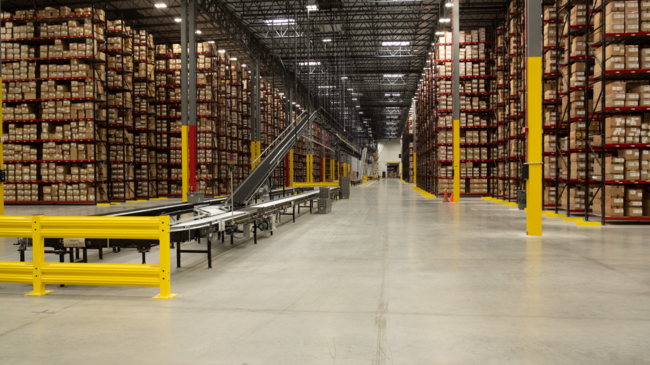
In the US, Under Armour is also using the omnichannel platform to further improve the fulfilment process. There, there are three distribution centres that Mulford's team can call on to handle online orders. "The initial problem was that the ERP system decided which DC it was assigned to per order line. That could mean that an online order with three order lines was handled in three different DCs. That led to frowned eyebrows among customers who received three different parcels a day later. Active Omni keeps the order complete."
Meanwhile, Under Armour also engages its own shops to handle online orders. In a month and a half, 'ship-from-store' was implemented in over 160 shops in North America, followed soon after by 'click-and-collect'. "By deploying those shops, we are even closer to the online customer. Some shops now ship 65 orders a day," Mulford states. "In Active Omni, we have entered the Fedex rates of all possible routes, as well as the staff costs that can vary from shop to shop. Do two shops qualify for an order? Then it goes to the shop that can handle and ship the order the cheapest."
Stock reliability
Mulford admits stock reliability in shops still leaves something to be desired. He has now started an RFID pilot to improve this. "Counting stock twice a year is insufficient. That is why we now still use a safety margin of five items to prevent employees from picking an item that is no longer in the store. If Active Omni indicates that the number of items in stock is less than five, that shop will no longer receive an order for the item in question. And if a shop does receive an order for an out-of-stock item, the platform ensures that the order automatically goes to another shop or a DC."
By deploying smart software, Under Armour is seeing its distribution network become a lot more sustainable. Online orders no longer come from three different distribution centres, but if possible from a nearby shop. Eddie Capel, ceo of Manhattan Associates, sees further opportunities to increase sustainability. "We have become used to the rhythm of ordering today and receiving tomorrow. But is it really necessary for that Saturday afternoon order to be delivered as early as Sunday morning? I am convinced that consumers will make different choices if we show their impact onCO2 emissions, for example."
More sustainable in three steps
According to Capel, retailers can make their fulfilment process sustainable in three steps. The first step is optimising transport planning so that trucks drive fewer miles and carry less air. The second step is to consolidate orders, for example by using an order management system. "Is it necessary for consumers to receive five deliveries a week? Or can we save them to one delivery at the time they are at home? The third step is about stock management. Make sure the right stock is in the right location. Is that not the case? Then that leads to extra kilometres and in some cases even air freight. Many traditional inventory management systems are focused on replenishing DC and shop stocks, but do not take into account new concepts such as click-and-collect and ship-from-store. That's where opportunities lie."











