Businesses and governments have a tough job to do in the coming years: greening the logistics sector. Dutch CO2 emissions must be reduced to practically zero by 2050.For logistics, this also means a major effort. What steps are needed? And how well are we already doing? An interview with knowledge institute TNO on Sustainability Day.
In recent years, TNO has been sitting around the table with various parties, including the Top Sector Logistics, to investigate how the growing transport sector can drastically reduce its emissions in the coming years.
Systeemverandering

TNO researchers Hans Quak and Jordy Spreen sum up the result of those efforts in a nutshell: changes are needed at system level. "Small partial solutions are not enough," explains Spreen, who works on sustainable logistics projects at TNO. "You have to look chain-wide. Not just at transport, also at bundling flows, optimising planning and making packaging more sustainable." This is difficult in a sector that is very fragmented, argues Quak, a specialist in urban logistics. "There are a lot of parties involved, unlike in the energy sector, for example."
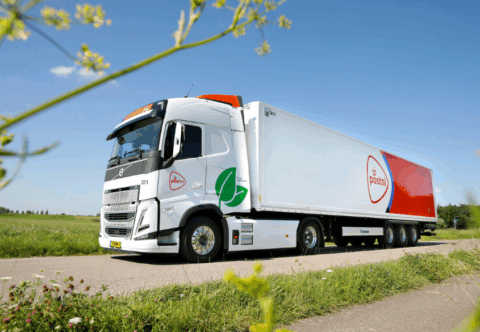
 One of the partial solutions often mentioned is electric transport. Many a delivery van already runs electrically and trucks will follow within a few years. Quak: "At the moment, electric trucks are still hardly available from manufacturers and diesel trucks are still being converted into electric trucks, for instance, but major parties like Volvo are developing new electric cars. These are very good developments, but we should not bet on one horse. We need specific solutions for specific flows. We don't yet know what the winning technology will be. For one segment, hydrogen or the bicycle courier might be the future winner and for another, electric. That's why at TNO we talk about 0-emission transport, not so much about electric transport."
Focus on efficiency
TNO sees that many companies and (local) governments are not waiting for the studies and regulations, but start working on sustainability on their own initiative. Quak: "That is good to see. They are switching to other modes of transport, planning more efficiently and packing differently. What you do notice in this is that the focus is on efficiency. If it is more efficient, then it is more sustainable. We are very happy with that, but it is not nearly enough to comply with the Climate Agreement. If the sector really wants to become more sustainable, we have to accept that this will require investments."
Local procurement
Which measures are often underexposed in the quest for sustainability? Collaboration may receive more attention, Spreen believes. "Pooling flows could possibly help. But that is difficult if parties find it difficult to share their data. Moreover, this measure is not always very visible. If you bundle two loads, there is still a truck somewhere."
In addition, little attention is paid to local procurement, Quak argues. The way companies procure determines the amount of trips made. "There are parties that already buy locally, but there is still a world to be won. What is the footprint of a particular order? Can you buy something locally that would otherwise come from far away? And does something really need to be delivered every day or can it also wait a few days? In that respect, the industry really needs to learn to unwind."
This awareness is also not yet sufficiently present among consumers. They let webshops be at their beck and call with same-day or next-day delivery and return products en masse. Spreen: "The situation we have created now is untenable. The mentality of us as customers has to change. However, I do not see that pessimistically. Things are already different now from a few years ago if you look at pick-up points, issued time slots et cetera. Couriers are already less likely to be at a closed door as a result."
Confidence in the future
Quak and Spreen want to stress that they are confident about the path to an emission-free future. "Sure, it is difficult, quite a change," Quak concludes, "That is why we have to start thinking in a different way and accept that this change will not happen by itself; this will take effort and money. If we do that, a lot really can be done. This is where TNO has an important role to play: providing factual information on how to make the system CO2 neutral, so that companies and governments can get started."