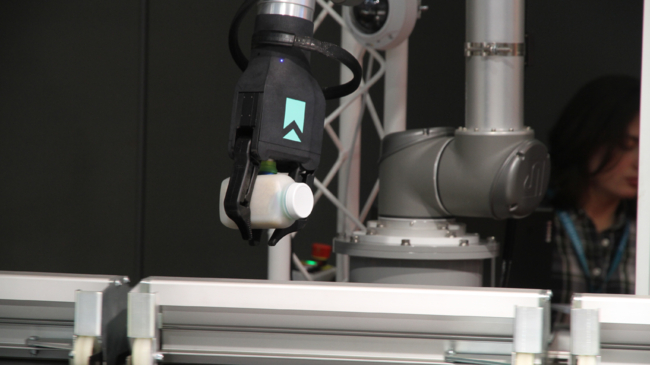
Still rotating machines attract that most attention at LogiMAT. This year, those are mainly order-picking robotic arms and high-speed shuttles. But the biggest innovations come from the artificial intelligence in those machines. One example is the award-winning algorithm for damping vibrations in masts.
Benjamin Berger has been working on it for five years: an algorithm that accurately calculates the vibrations in a mast of a warehouse crane. The longer the mast and the higher the travel speed, the greater the vibrations when the crane decelerates. That means the crane has to wait before striking or knocking out a pallet or bin until the vibrations disappear. The algorithm minimises the vibrations in the mast. This not only leads to higher performance, but also prevents overloading of the mechanical structure. This results in fewer hairline cracks in the base of the mast.
Algorithm was awarded the prize for best product in the software, communication and IT category at LogiMAT. The was named SEOS: Speed and Energy Optimisation System. The algorithm calculates the behaviour of all components at a given speed and load. This is done partly on the basis of technical specifications, but also partly on the basis of several test runs in the warehouse. The algorithm then determines how the crane should accelerate and decelerate to avoid vibrations. This means, for example, that a crane starts slower and only then accelerates.

Fewer machines
The algorithm has now been applied in high-bay warehouses housing cranes from manufacturers such as TGW and Stöcklin. The results reported by Berger Engineering are spectacular: the inbound and outbound capacity in these warehouses has increased by 40 per cent thanks to the algorithm. In the high-bay warehouse of a Swiss watch manufacturer, this led to a 233 per cent increase in acceleration. Because the motors and drive assembly are also spared, the service life of these rotating parts is extended.
For now, the spectacular results have not made all crane manufacturers want that algorithm right away. At least that is what father Bruno Berger tells us at LogiMAT, where his son is in constant conversation with interested customers. Bruno Berger himself has a a company that produces rail systems for warehouse cranes, among other things, so he knows this world well. "With this algorithm, four warehouse cranes do the work that previously required six warehouse cranes. So if they build that into their controls, they sell fewer machines. That's why we also target end customers directly."
Machine learning
Tucked away on the DistriSort stand is Righthand Robotics, a startup from the US that specialises in 'piece picking'. What sets this robot apart from others at LogiMAT is the way the gripper and artificial intelligence are aligned. "We have developed both the gripper and the algorithms ourselves. That allows us to fine-tune both. That means we can pick up a wider range of items and achieve higher speed and reliability," says co-founder Leif Jentoft of Righthand Robotics.
The robot consists of a standard robot arm from Universal Robots, to which a gripper with both three fingers and a suction cup is attached. The device grabs a variety of items from a bin and places them on DistriSort's sorter. Jentoft: "Our robot can pick up to a thousand items per hour. We apply machine learning, which means our robot learns from every pick. If you open a second warehouse elsewhere with the same range and assortment, a second robot in that warehouse can use all the knowledge gained in the first warehouse."