In the overcrowded labour market, warehouse workers are hard to find. That forces warehouses to deploy their people even better, but how? A smart labour management tool can help. But then it has to be deployed properly, a Manhattan Associates user conference shows.
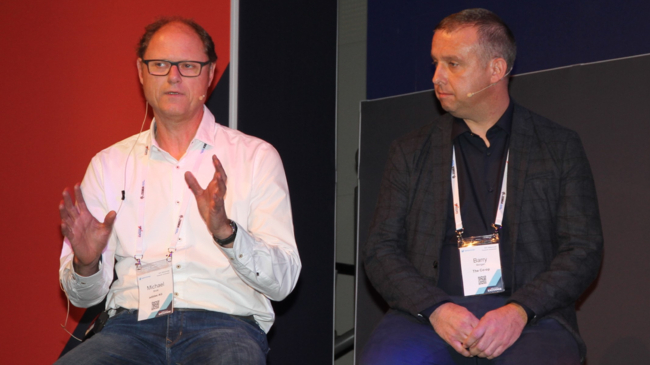
In warehouses where every operation is confirmed with a scan or voice command, it is easy to measure how many picks an order picker does. But how fair is the resulting figure? "We are all used to measuring how many packages we collect per person per hour. But it's not fair if one person only collects boxes of biscuits and another collects bags of potatoes," says Barry Morgan, solutions specialist at UK supermarket chain Co-op.
Measuring productivity honestly
Co-op uses the labour management system of Manhattan Associates, supplier of supply chain software. This system also measures the productivity of order pickers, but against a standard time calculated based on specific characteristics of the picking order. "So this system takes into account the dimensions and weights of the products to be picked," Morgan told a panel discussion at Manhattan Exchange, Manhattan Associates' annual customer conference.
Labour management can be used not only for order picking, but for any activity in the warehouse. The system shows in which activities an employee is and is not good. "After all, people have different competences. By making these transparent, we can use our employees in the best possible way. This also has a positive effect on the people themselves," said Morgan, whose company has 12 distribution centres in the UK.
Understanding waste
Adidas has 16 distribution centres, but spread around the world. The sportswear giant also uses labour management, but not in the same way at every location. "That has to do with the culture in a country, with privacy laws, with unions and the works council. In some countries we measure productivity at the detail level, in others only at the team level," says Michael Bode, vice president of distribution solutions at Adidas.
More than a tool to deploy people more efficiently, labour management is a tool for continuous improvement. At least for Adidas, which adheres to the lean philosophy. "The system makes the processes in the warehouse transparent. It shows where waste occurs and therefore where opportunities exist to design processes more efficiently. If goods receipt in our distribution centre in Hong Kong is more efficient than in Osnabrück, that is cause for further investigation and the starting point for a discussion," says Bode.
Making work more enjoyable
Important not to antagonise employees when introducing labour management. "Attention to change management is required. Take employees by the hand when labour management is introduced," states Bode, who stresses that people must be treated fairly. Especially in this era when people are increasingly difficult to get. "It is not about firing poorly performing people or making their lives impossible by hounding them."
Indeed, labour management can help make work in warehouses more enjoyable. "People get insight into their performance and progress. We can see where they need extra training. So that also gives people the opportunity to develop themselves further," says Bode, who considers the role of supervisors particularly important. "They should not constantly beat their people up with figures. We should not misuse the information. That would be 'killing'."