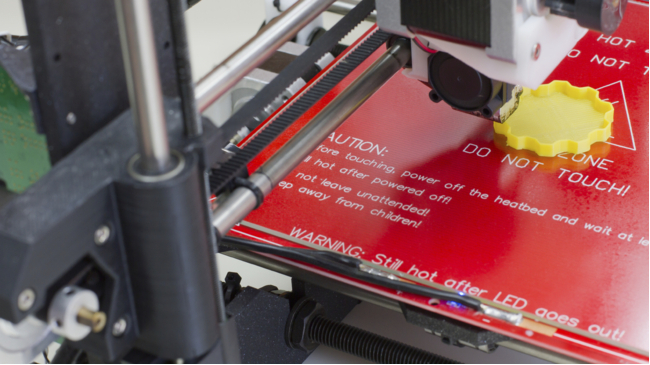
Logistics will be hit hard by the rise of 3D printing. ING states in a report.
Strong growth of 3D printing
The technology currently has little impact on the global economy, but that will change in a few years. Indeed, over the past five years, investment in 3D printing has increased by 29 per cent. If that growth continues, 3D printing will completely shake up the manufacturing industry, ING expects. By 2060, half of all manufacturing products will come from a 3D printer.
Companies and countries can benefit. For example, local production will become possible, bringing jobs that have disappeared to low-wage countries back to a company's home country.
On logistics, however, 3D printing is taking its toll. Precisely because the printers enable local production, international trade will decrease. Firstly, because less transport of materials is needed. Secondly, because finished products are closer to the end customer. ING expects 3D printers to thus ensure that there will soon be less work in the sector.
Product throughput decreases
According to Raoul Leering, head of international trade research at the ING Economics Department, the weakening of world trade growth will have negative consequences for the Netherlands mainly in ports, international wholesale trade and the transport and logistics sector. "These are heavily dependent on world trade. Not only because of the many imports and exports for and by the Dutch but also because of the function of the Netherlands as a transit country." Just the transit of products through the Netherlands alone currently earns the sector 31 billion euros, ING knows. "Logistics service providers who do warehousing and European distribution from the Netherlands will start to notice this."
Editorial LogistiekProfs











