The convenience of apps that we know from our own smartphone or tablet is penetrating ever deeper into logistics. More and more warehouse workers already use an app for order picking, but the number of apps on their devices is only expected to increase. During the trade fair ICT & Logistiek from 28 to 30 November, many ICT suppliers will show what value they add with their apps.
The IT landscape in logistics is changing. The traditional warehouse management, transport management and ERP systems will retain their function, but are no longer sufficient to support the supply chain of the future. This requires other solutions, writes consultant Jeroen van den Berg in his vision of the supply chain for 2020. Mobile apps are an important example of this. "These mainly serve to share information with employees and external relations anytime and anywhere," Van den Berg explains. "Think of the employees on the floor who have to collect, pack and ship orders, but also apps for taking stock or scanning documents. In addition, more and more systems offer beautiful dashboards that provide insight into operations via smartphone or tablet."
App for order picking

Davanti is one of the WMS vendors that has developed apps. These apps are integrated with CORAX, Davanti's WMS. They are used by employees on the floor for, for example, order picking. "For that kind of process, we only work with mobile apps anymore," says Marcel van Etten, responsible for business development at Davanti. "In the past, we built applications specifically adapted to each device. If a customer then decided to deploy a different device, we also had to adapt that piece of software again. That is no longer necessary with mobile apps. Those run without adaptation on any device with an Android, Windows or iOS operating system."
CORAX's apps are only intended for execution of operational processes in the warehouse. No apps have been developed for managers who want insight into, for example, the progress of the operation via their smartphone. The question is whether that is a problem. "CORAX is a fully web-based system that runs in the cloud. That means the system can be accessed via any device with an internet browser, including a smartphone or tablet. That is handy for managers and planners, but not for order pickers. You don't want to give them access to the WMS in such a way. They only need a simple application that leads them through the process step by step without distraction," says Van Etten, who admits that an app is often more user-friendly. "We are thinking about making certain dashboards available via an app, so that a manager can quickly check how busy it is before he drives away from home in the morning. At the request of a customer, we recently added functionality for dock scheduling to CORAX. It might be interesting to make this available via an app, so that a driver can also check which dock is reserved for him.
Photo sharing and archiving

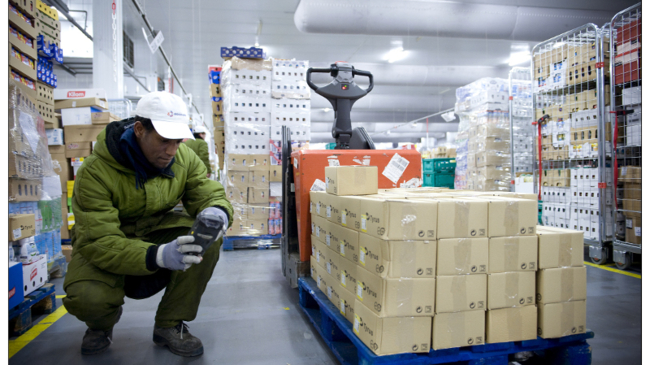
Besides apps for standard processes like order picking and goods receiving, the market also offers more and more apps that focus on specific applications. One example is CargoSnap, an app that allows everyone in the warehouse to easily take, store and share photos. According to Marcel Merkx of CargoSnap, every warehouse operation has at least two moments when the app proves its value. The first is at goods receipt, when a photo can provide proof that a pallet has arrived damaged. The other moment is when the goods leave the warehouse, where a photo of the shipment allows the company to hedge against future claims. "When goods are received, it is important to share photos of damaged goods with suppliers as soon as possible including time and location. With CargoSnap, every photo is available on the back office within a beat. When shipping, it is precisely the case that photos should be properly archived so that they can be quickly retrieved later. We facilitate that too with a cloud solution," says the founder of the Utrecht-based start-up.
Taking photos during receipt or dispatch of goods is already daily practice in many warehouses, Merkx agrees. "But now this is often done with a smartphone or digital camera, which is read at the end of the day in the office. It then has to be manually figured out which photo belongs to which order in order to archive it. With our app, it is possible to link each photo to the right order by scanning a barcode on the pallet or loading list. Our oldest customer in Moerdijk took as many as 70,000 photos in one year and saves a lot of time this way," explains Merkx, whose app is currently being used by companies from the Netherlandsand, the United States and Brazil.
Developing and managing apps

With the proliferation of apps, the need for companies to efficiently develop, deploy, integrate and update all those apps is also growing. This can be done with a mobile enterprise application platform like the one Zetes provides. "With such a platform, companies only need to build an app once, after which it is suitable for every device and operating system. Even standard apps from other parties, can be managed through this platform. Thanks to the use of APIs, they can be integrated with any ERP, warehouse or transport management system," says Paul Lankhout, country manager of Zetes in the Netherlands.
Demand for such platforms has grown rapidly in recent years, says Lankhout. "You implement an ERP or WMS for five or 10 years, maybe even longer. However, the speed at which business operations change requires apps that are available much faster. With these, companies can realise small but valuable process improvements. They don't want to wait six months or even longer before a new module of an ERP system is developed and implemented."
To use or not to use a smartphone
The popularity of apps also impacts the hardware used in warehousing and transport. Devices running the Android operating system are rapidly gaining ground on the longstanding Windows CE system, but these do not necessarily have to be industrial devices. Inexpensive standard smartphones developed for the consumer market can also be used for order picking or stock inventory, for example. "An industrial device is more robust, but also more expensive and equipped with a less powerful processor than, say, an iPhone. What is the best choice varies per customer," states Van Etten. "In a cold store or freezer warehouse, a smartphone will quickly fail. But in very large warehouses where only full pallets go in and out and only a few scans a day are needed, a Wi-Fi network might not even be necessary. Especially if employees are also active in the outside area, a smartphone with a 4G connection may then be more attractive."
Lankhout sees that most warehouses of any size are still better off with an industrial device. "These are specially designed for intensive use and can take a beating. Anyone who continuously scans barcodes all day long, constantly calls on the bluetooth connection with a scanner or mobile printer and constantly contacts the Wi-Fi network via the radio card, demands a lot more from their battery than a standard smartphone can handle. Don't forget that with a consumer device, you also get the Google Mobile Services (GMS) included, which constantly demand updates to apps and the like. That eats up memory and energy, which you are not waiting for while order picking. Manufacturers of industrial hardware respond to this with non-GMS versions, which make updates and the like much more schedulable."

Switching between apps
Lankhout also points to the user-friendliness of a device. Those who scan a thousand barcodes in a day would like a device that is convenient to operate. "Also think about voice picking. For that, you can in principle apply Google's voice function, but the question is whether the quality is as good as the speech engines developed specifically for voicepicking. A score of 99.0 instead of 99.8 per cent is already a big difference then. If employees have to repeat one in a hundred words, not much remains of the desired increase in productivity," says Lankhout.
One thing is clear: the proliferation of apps means that employees will soon enter the warehouse with devices running multiple apps. Depending on their task, they can deploy the app they need. Have they finished voicepicking? Then they close that app to open the stock inventory app. Are they busy with goods receiving? Then they switch apps to view the dock planning, sign a digital waybill or take a picture of the load. And maybe they use whatsapp to consult with planners or supervisor in between jobs. Multimodal, Lankhout calls it. "For that too, it is important to manage all those apps properly. Which employee has access to which apps? That too can be done with a mobile enterprise application platform."
ICT & Logistiek will take place on 28, 29 and 30 November at the Jaarbeurs in Utrecht with the theme Digital Supply Chains. The fair will be held simultaneously with Logistica 2017. Registration for both exhibitions can be done here.











