CeMAT 2016 was less grand than previous editions. Nevertheless, this logistics trade fair in Hanover gave a good impression of trends and developments in logistics. Below are three innovations that give a good impression of developments in intralogistics.
1) Self-driving order-pick trucks
In retail and wholesale warehouses, drivers of order-pick trucks lose a lot of time getting on and off the truck, sometimes only to drive the machine a few metres further. In recent years, several order-pick truck manufacturers have come up with solutions to this. One example is Crown with a glove-integrated remote control. At the LogiMAT in early March, Still demonstrated an orderpick truck without a remote control, which follows the order picker closely like a robot. This concept was also on display at CeMAT.
In the pavilion next door, Jungheinrich also showed a remote control order picker, which in this case can be attached to the waistband and operated with a simple tap. Unlike Crown and Still's order-pick trucks, this machine is controlled by the warehouse management system. As a result, the Jungheinrich truck looks for the next, correct picking location itself and is not dependent on the picking location chosen by the order picker.
2) Foil with 'Easy Opening'
Packing pallets in foil prevents falling loads, reduces product damage and increases safety in the warehouse, but removing the foil is a crime. Without a sharp knife, it is often impractical.
Beumer comes up with a solution: a rack cover with 'Easy Opening'. This stretch cover features a black stripe that marks the line at which the film is weakened. At this point, the film can be easily pulled open without tools as if it were a pack of rusks. Not only does this save a lot of time, it also prevents injuries and damage to products by using knives.
Beumer assures that the film is only weakened, but not perforated. This means that the stretch cover remains waterproof. This is particularly important for packaging of building materials, for example, which has to be weather-resistant.
3) Compact shuttle system
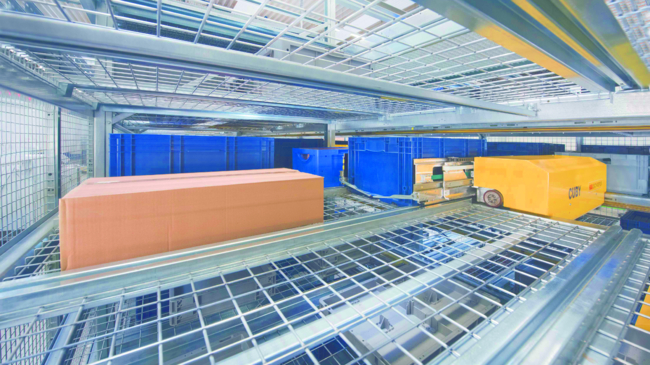
Following the example of many other warehouse fitters, SSI Schäfer now also has a modern shuttle system: the Cuby. This system contains shuttles that remove plastic totes from racks and take them to order picking stations. SSI Schäfer already had a shuttle for totes, but with this Navette, only one shuttle could be used per zone of four levels. Its capacity is lower than the Cuby, which allows a separate shuttle to be deployed on each level.

The construction of the racking in the Cuby system is striking. The plastic bins lie between two profiles with a few millimetres of space between the storage locations. SSI Schäfer uses this space to guide the telescopic arms that pull the totes out of the racks. These 1.4-metre-long arms can normally swing quite a bit, which is kept to a minimum thanks to the guide rails. As a result, the German warehouse operator needs to build in fewer tolerances than in other shuttle systems, leading to higher storage density. The disadvantage is that the width of the storage locations is fixed, which is disadvantageous if companies also want to use narrower load carriers such as boxes.
Marcel te Lindert - journalist logistics & supply chain
Stay up to date
Sign up for the newsletter and receive the latest news, trends, innovations and developments from the sector.











