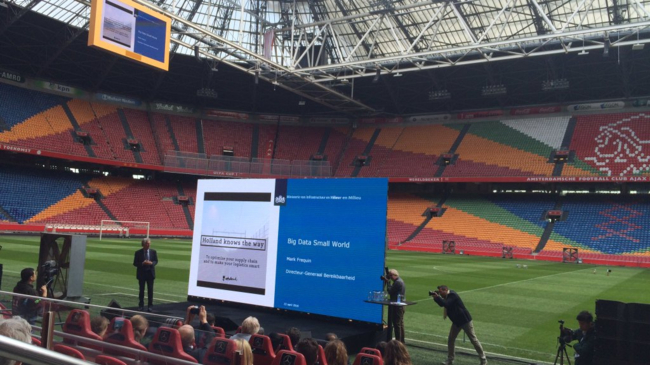
"The Netherlands has a good position in terms of logistics flows and data flows. We need to interlink these." So says Mark Frequin of the Ministry of Infrastructure & Environment at the start of the annual congress of the Top Sector Logistics. He is joined by trend watcher Sander Duivestein, who sees a future with decentralised networks in which data act as the new oil. "Every company will become a technology company," he said.
That the Netherlands holds a leading position in logistics is well known. Less well known is the Netherlands' strong position in data. International companies like to locate their data centres in the Netherlands, close to the internet hub in Amsterdam. "And if cables come out of the ocean anywhere, it is in the Netherlands. We have a great infrastructure and great availability of broadband internet," says Frequin, director general of Accessibility at the Ministry of Infrastructure & Environment.
Accelerating processes
If we succeed in interlinking those flows of goods and data, we can become the world's smartest logistics country. Frequin refers to the Neutral Logistics Information Platform (NLIP), which should enable shippers, forwarders, carriers, main ports and governments to share information with each other. "Many parties now understand that we can speed up processes if we share information in advance. The important thing is to agree on data, interfaces and standards in that area."
Frequin calls on companies to unlock their data to create more value. He shows a picture of Dagobert Duck swimming in his money warehouse. "One thing we know for sure about Dagobert: his money is not leaving the warehouse. That must not happen with data. We have to use that. As a government, we also participate in this. We have a lot of data with customs, tax authorities and the Department of Public Works that we are happy to make available and convert into meaningful information."
Decentralised networks
After Frequin, trend watcher Sander Duivestein also called on companies to especially speed up. After showing a large number of technological innovations, he indicates that we live in an era of accelerated change. "We are moving from linear to exponential change. The problem is that many companies tend to perpetuate problems for which they themselves were once the solution."
Frequin foresees a future in which we go from centrally organised companies to decentralised networks. Data act as the new oil in those networks. "Look at Uber that doesn't own a single taxi itself or Airbnb that doesn't own a single room. These are companies that employ less than five thousand people but are worth billions. We are moving towards an automated economy where technology is taking over not only more muscle power, but also more and more brain power.
Nimber and SKUchain
Uber-like concepts are now penetrating logistics as well. Duivestein mentions Nimber, a peer-to-peer service that allows people to ship products from A to B with people who are going that way anyway. Another example is SKUchain, a company that uses blockchain technology to build products for international trade and supply chain finance. "But think also of a soda machine that sends its own request to replenish stock. Whoever responds first gets paid out in bitcoins."
Whatever the future brings, the one constant is that we live in an era of accelerated change. Duivestein urges the 1,100 spectators in the stands of the Amsterdam Arena: "Every company is becoming a technology company. Please get started. And above all, don't think it will take your time. It really won't."
Marcel te Lindert - Journalist logistics and supply chain
Stay up to date
Sign up for the newsletter and receive the latest news, trends, innovations and developments from the sector.











