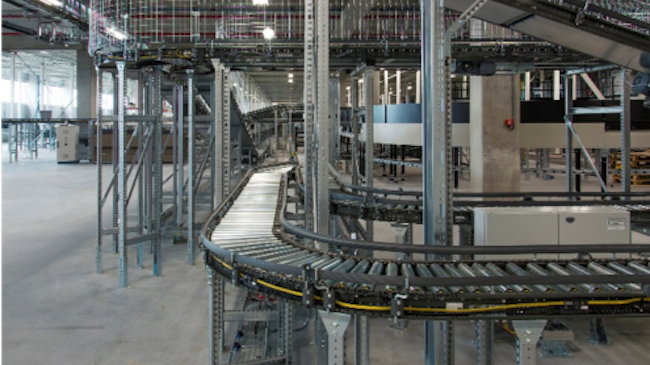
Glenn Verhoef, commercial director at Van Berlo I Experts in foundations and industrial floors, talks about the essential cooperation in the design of distribution centres between the supplier of automatic systems and Van Berlo.
"Due to the ever-increasing performance requirements of a distribution centre, and thus also the floor, it is essential as a flooring expert to be involved at an early stage by the client/end user, in order to align the floor's requirements with the material handling system that will be used."
Flatness requirements vs. deformation requirements
Narrow aisle distribution centres have high floor flatness requirements Narrow-aisle trucks must be able to drive through the aisle at high speed without hindrance.
"In recent years, many automated warehouses have been built, where efficiency hardly depends on available staff. In the case of automatic warehouses, the focus is not so much on the flatness of the floors, but particularly on the deformation requirements," Verhoef says.

Deformation requirements
The high deformation requirements stem from the requirement for moving parts to work together correctly. If too much deformation occurs, the process in the system could be disrupted, for example if a crane or lift ends up at the wrong height. Basically, the high deformation requirements lie in the material handling system itself. The requirements are then projected onto the foundation, which in most cases consists of a floor. The stakes for a well-functioning system are very high, so the deformation requirements are stringent.
Suppliers of material handling systems refer to standards such as FEM 9.831-1 and FEM 9.832. The standards talk about rotations of 1:3000, which means that 0.33 millimetres of deformation may occur over one metre. This is about a factor of ten smaller than common deformation requirements in the construction industry.
"The material handling system and the foundation influence each other. The distribution of forces depends on the stiffness ratios of all components in both the system and the foundation. Think of foundation piles, steel beams and so on. Ultimately, deformation occurs based on the distribution of forces."
Consulting engineering firm
Verhoef continues: "Our internal engineering office, Van Berlo Engineering, is able to think along with the wishes and requirements of the client, end user and supplier of the material handling system at an early stage. The result is optimal (and often cost-saving) advice regarding the floor design. We pull together and now have a number of wonderful reference projects. Cost savings can often be made on the thickness of the floor, which also saves time by speeding up implementation. A win-win situation for all parties involved."











