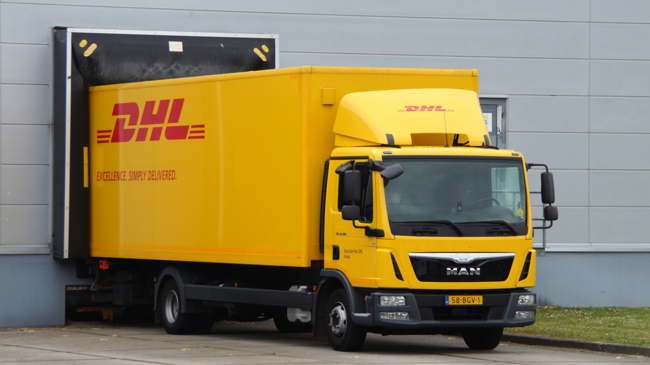
DHL wants to make better use of space in trucks by deploying taller roll containers. The roll cage contains 10 per cent more space than current models and thus contributes to reducing CO2 emissions. A trial conducted by DHL at Wehkamp proved successful.
So says Thijs Daalhuizen, process manager at DHL in an interview with Thuiswinkel.org. The carrier investigated vehicle loading in the e-commerce sector with parties such as Connekt and Thuiswinkel.org. This shows: the floor space of trucks is well utilised, but the height is not. In fact, space remains above the roll containers.
Ideal height
Daalhuizen: "Until now, the height of the roll cage was seen as a given, in fact nobody knows anymore what the original reason for this size is. We therefore started looking at what an ideal height actually is."
Participants in the study initially tested a 2.5-metre roll container. Then the space in a truck is optimised, but employees need a ladder to fill the roll container. "That obviously doesn't work. We eventually arrived at a roll container that contains 10 per cent more space than current models. The top is 15 centimetres higher and at the bottom it is slightly lower."
Reducing CO2 emissions
Whether DHL actually needs 10 per cent fewer trucks remains to be seen in practice. "It depends, for example, on how full the roll container actually ends up being loaded and how full the last truck of the day was. But in the end, we indeed think we will recoup the investment in fewer truck trips. So that results in a substantial reduction in CO2 emissions. Moreover, it also helps us in issues surrounding the scarcity of workers. Good drivers are hard to find."
To ensure employees are not put under greater strain, there is a strip on the roll cage at a height of 1.75 metres. Above that, no heavy packages may be lifted into the container.
Adjustments needed at online shops
DHL will replace 25 per cent of its current roll containers for the higher variant. This is because the higher roll container cannot yet accommodate all customers. At Wehkamp, for instance, adjustments were necessary because shipping bags are loaded automatically. The height at which this is done first had to be adjusted to the new roll containers.
Afbeelding: Jarretera / Shutterstock.com











