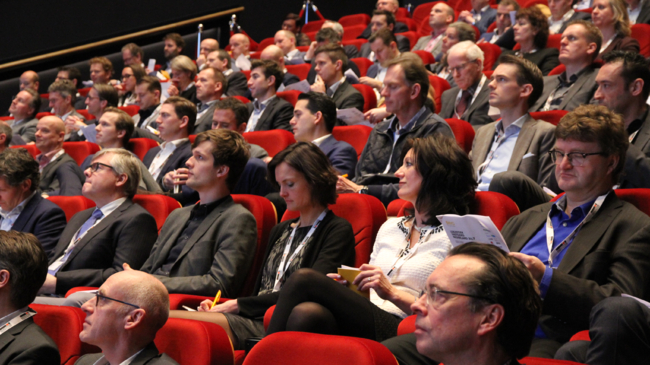
The demand for new warehouses and distribution centres will remain as high as ever in the coming years. That was the prevailing tenor during the Logistic Real Estate 2017 congress. However, the location and design of those properties will change, think multi-storey warehouses in inner cities. The digital and circular economy are driving that change.
The stock of logistics real estate has grown from 20 to 28 million square metres in a few years. For this rapid growth, Paul Bleumink, managing partner of Buck Consultants International, cites two reasons: the consolidation trend among logistics service providers and the growth of e-commerce. During the well-attended conference, the name Lidl, which recently announced it was building a new e-commerce distribution centre in Roosendaal with work for as many as 1,200 people, is mentioned. "Developments are happening so fast that the various authorities are lagging behind in terms of knowledge. They still talk about big grey boxes and extensive use of space, but that is no longer the case."
Also read: 3 trends in logistics real estate
The growth of e-commerce is leading to the construction of new distribution centres that look different than usual. "There are many more people working, spread over several mezzanine floors. That also means higher energy costs to heat the whole thing and more focus on automation. And we will see fewer large docks, but many more small loading and unloading stations for delivery vans," Bleumink argues.
Double-layer warehouses
A consequence of e-commerce is a growing need for urban distribution centres, not only on the outskirts of cities but also in the middle of cities. Examples can now be found in Paris and Berlin, set up to deliver consumers at lightning speed. One challenge is the available space in those cities. Double-layer warehouses, not-done in the Netherlands, are now coming back into the picture. "In that respect, we can learn something from Japan and Hong Kong. There, we build warehouses of up to 26 layers," says Philippe Van der Beken, Goodman's general manager in Europe.
Roger Peters of Patrizia Logistics, founded a year and a half ago, put the focus mainly on the development of logistics centres in cities. "Think of integrating warehouses in office buildings, but also in covered shopping malls. The trend is that shops are getting smaller and smaller, but those shops want to give customers a product at the end of the day. You can think of a building with distribution on the ground floor and shops on the first floor, connected via paternoster-like systems."

Jonas van Stekelenburg, director Cargo Schiphol Group.
The growth of e-commerce is even impacting logistics real estate at Schiphol. The locations for first-line handling of air cargo have been forgiven, so here, too, the construction of double-storey buildings is being considered. "Our volume has remained roughly the same in recent years, but the number of customs declarations has increased by 10 to 15 per cent. Cause: the increasing number of small shipments. Everyone orders from Alibaba these days, including me. We are therefore not looking for it in more space, but in more efficient use of the existing space," says Jonas van Stekelenburg, director of Cargo Schiphol Group.
Read also: Companies must look beyond the lowest price per square metre
Circular economy
What is also going to have a major impact on the design of logistics real estate is the circular economy. At least that is Bleumink's view. "We talk a lot in the Netherlands about circular economy, but in fact we still do quite little recycling. Circular business parks? I don't know them." Arthur van Dijk, president of Transport & Logistiek Nederland, agrees with Bleumink. "When I think of circular economy, I feel ashamed. The Netherlands is number one in logistics, but when it comes to recycling, we get no further than some plastics, agrofood and building materials. The circular economy is all about logistics."
 Arthur van Dijk, chairman of Transport & Logistiek Nederland
Good, here and there experiments are being made with the use of sustainable materials in the construction of distribution centres, but they are not yet ready for the market. Cooperation in chains to organise return flows and overhaul or recycle returned products? "It hardly happens. There is a great need for logistics service providers to develop a vision on this," Bleumink argues. Van Dijk: "Think about setting up material banks for recovered raw materials. If we start doing that, the circular economy will start coming to life. There are great opportunities here."
Marcel te Lindert - journalist logistics & supply chain











