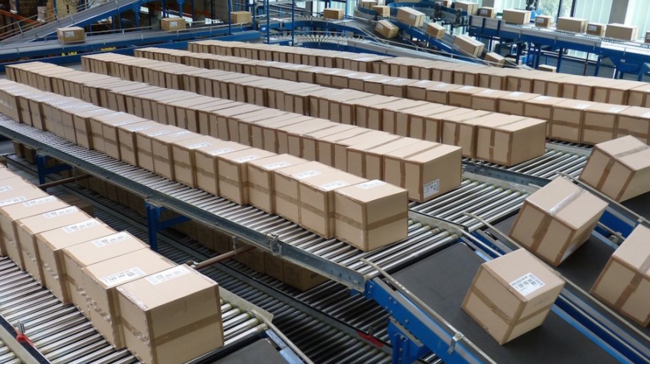
A 'box-to-size' machine scans the dimensions of each order and cuts a box to the smallest possible size. This box is then folded around the order, glued shut and labelled ready for shipping. The machine is completely flexible in terms of shape, dimensions and the number of products (singles or multiples) to be shipped in one box.
Is a ‘custom-sized box’ machine sufficient? Does a combination of a machine and stacking tools generate an even higher profit margin? We share our view:
1. Reduction in transport volume
A ‘custom-sized box’ machine promises a 50% reduction in volume compared to standard boxes, resulting in lower transport costs, no unnecessary filling material and approximately 20% less cardboard consumption.That’s true, when it comes to just one product. But how often do you send just one product? To dispatch a multi-pack, your employee must first manually stack the items in the most efficient way possible before creating a ‘custom-made box’. A stacking tool will first calculate the optimal stacking configuration and then provide a box of the appropriate size to accommodate the smaller volume.
2. Number of orders per day
Each boxing machine has a maximum number of orders per day. Some process 500 orders, others easily handle 1,000 orders or more per day.What at peak periods such as Christmas and Sinterklaas? Chances are real that your machine cannot handle the influx and you have to bring in manual packers. The reduction you gained from the 'box to measure' machine disappears with manual processing. A stacking tool then provides visual instructions that will make your stacking faster and more efficient
3. Smallest possible box without filler
The machine always promises the smallest possible box without filler, but in reality this is not always possible. After all, every machine has to deal with a range. Suppose your machine has a range of 20cm to 100cm in height. What do you then do with products that are 10cm high? For this, you still need filling material. A stacking tool works with standard packages that are not linked to a range, allowing you to use even smaller (or larger) customised boxes.
4. Stacking after 'bespoke box'
Packing your products in an optimal box is only the first step. Now you also need to place them efficiently on a pallet and send them with your carrier. For this step, a 'box-to-size' machine does not offer a solution. Especially with 'high mix -low volume', it sometimes allows you to ship a pallet more than necessary.
Is a stacking tool better than a 'box to size' machine? No, but it is a great addition!
Johan Faes - Consultancy in packaging
Stay up to date
Sign up now for the LogistiekProfs newsletter and receive the latest news, trends and offers.











