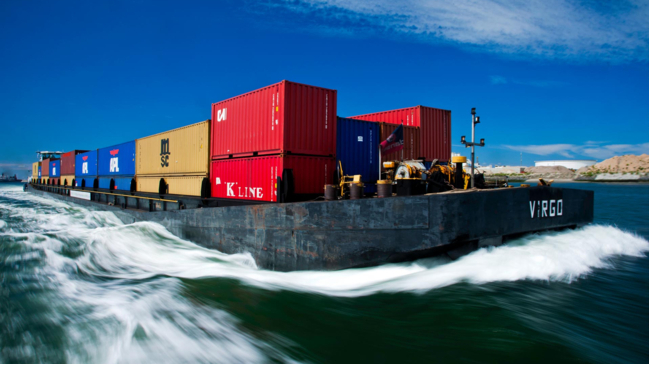
Dutch inland navigation will continue to grow in the coming years, but less rapidly than before. This emerges from a medium-term forecast by research firm Panteia. For 2017, Panteia still expects growth of 2.5 per cent. In subsequent years, that growth will drop to 1.1 per cent per year. This is mainly due to a reduced decline in coal volumes.
Panteia distinguishes between the transport volumes of dry cargo shipping, tanker shipping and push-towing. Among other things, the research firm expects an increase of 21 million tonnes in transport volumes for dry cargo vessels until 2021. In addition, estimates show that tanker shipping will carry over 6.6 million tonnes of additional cargo in 2021. For push transport, Panteia expects a limited decrease of 1.8 million tonnes.
Container transport important growth segment
Dry cargo vessels and compositions thereof transported a total of 173 million tonnes of cargo in 2016. Of this, 71 million was destined for the domestic market and 63 million was exported, mainly to Germany and Belgium. From those countries, 39 million were imports. To 2017, a transported volume of 181 million tonnes is expected; to 2021, this will develop to 194 million tonnes.
The most important growth segment until 2021 is container transport. Almost 40 per cent of the increase in dry cargo vessels can be attributed to container transport. Newly opened container terminals in Almelo, Doesburg, Lelystad and Weert contribute to this.
More chemicals, less cement and fly ash
A total of 100 million tonnes of wet cargo was transported in 2016. Of this, 35 million was destined for the domestic market, 39 million was exported to Germany and Belgium in particular and 26 million was imported from those countries. A limited decrease to 99 million tonnes is expected for this year.
Panteia expects 107 million tonnes to be transported in tanker shipping in 2021, an increase of 6.6 per cent compared to 2016. Of this, 36 million tonnes will be domestic transport, 42 million tonnes export and 29 million tonnes import. Growth is seen mainly in the transport of chemicals: up 10 million tonnes. In contrast, imports of cement and fly ash by powder tanker are decreasing.
Pusher craft: increasing volumes domestically, decreasing exports
In 2016, pushers carried a total of 45.5 million tonnes of cargo. Of this, 10.1 million was destined for the domestic market and 33.6 million was exported mainly to Germany and Belgium. Only 1.8 million tonnes of imports took place from those countries. A limited increase to 46.2 million tonnes is expected for this year.
For 2021, however, Panteia expects a 3.9 per cent drop in push transport (compared to 2016) to 43.7 million tonnes. In domestic transport, increasing use of push barges is foreseen, mainly in the transport of animal feed by push barges. However, international transport with barges is decreasing by 10.4 per cent. This is due to the shift of coal and ore transport from pushed convoys to tying links with one to even three pushed barges.
Editorial LogistiekProfs











