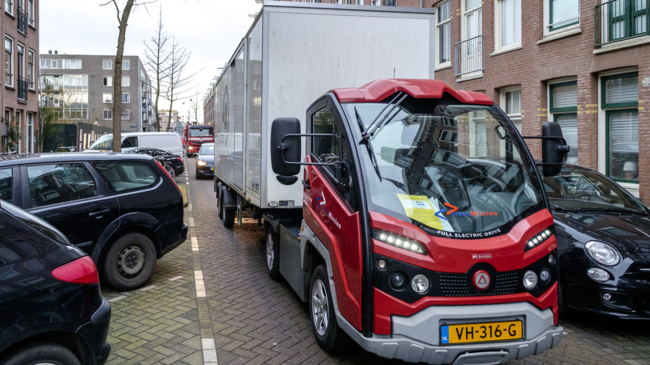
If it were up to Transport en Logistiek Nederland (TLN), professional freight transport would no longer pollute inner cities from 2025 onwards. By then, the supplying of inner cities should only be done with electric vehicles, the industry organisation reports today in the Financieele Dagblad.
TLN's ambition is also to reduce emissions from all professional freight transport to 50 per cent of 2015 levels from 2030.
According to TLN president Arthur van Dijk, it is important that the sector itself takes the lead in sustainability. "There is definitely a fear that there is only talk about us. We don't want to wait until bans might be imposed on us," Van Dijk told the FD.
Suppliers of zero-emission vehicles
TLN outlines a number of preconditions for its ambition. For instance, there must be at least two truck suppliers who can supply enough emission-free vehicles in time.
In addition, the industry association expects the 40 largest municipalities to publish their definition of 'inner city' by next year at the latest. That definition will apply as an area for emission-free transport from 2025. Many entrepreneurs are reluctant to invest in new equipment, according to TLN, because they do not know whether they will be allowed to drive it later. "That is why it is good to build picket lines now to create certainty in the future."
Subsidy scheme
In order to achieve the CO2 reduction, an abolishment rule for the use of biodiesel and biogas must be put in place, which requires subsidies, Van Dijk believes. Otherwise, entrepreneurs could run into problems during the transition phase to other equipment. How much subsidy is needed is still unclear. "But it has to be temporary. We need to get to a situation without subsidy as soon as possible."
Editorial LogistiekProfs











