A self-driving car on the daily streets suddenly seems to be a matter of course after years of seeing videos of equipment-laden cars on lonely test circuits with no pedestrians and cyclists crossing the road. These developments are happening at lightning speed and have long passed the science fiction stage, with experts talking about a new market worth tens of billions of euros in the coming decades.
In the intralogistics market of lifting and order picking trucks, conveyors, sortation systems and advanced storage systems, the technology is more fragmented and the commercial potential is naturally much lower which may explain why the real game changers have so far failed to materialise.
, held once every three years
CeMat in Hanover has for years been known as the materials handling trade fair that suppliers choose as the prime opportunity to showcase their latest innovations. According to logistics magazines, this triennial ‘toys for boys’ event once again attracted fewer exhibitors and visitors in 2016 than in previous years. And that’s strange, because there’s considerable investment in mechanisation and automation, so a lack of interest can’t be the reason. Has a mismatch gradually emerged between the technology on display and what is actually needed? I often hear people complaining that, after a day of wandering around, they can no longer see the wood for the trees and haven’t really seen anything new. Product launches invariably focus on the innovation or improvement of a single device or software package from one specific supplier. The likelihood of this actually leading to a revolution seems slim. True innovation usually stems from a combination of solutions or techniques. And, given the costs involved, it’s hardly possible to demonstrate this at trade fairs.
Autonomous ‘
’
This year, forklift suppliers are introducing order-picking trucks which, whether or not linked to the WMS, follow behind the order picker on foot and stop precisely at the picking location so that the order picker can fill the pallets or roll containers the truck has brought along. This only saves time if the driving distances are limited and a large number of order lines need to be picked, as this allows for savings on the time taken to get on and off the truck.
The next step is already on the way. The self-driving order picking truck is being used as an affordable AGV in a Zone pick concept to transport partial orders from zone to zone. A conventional Zone pick system uses conveyors to send order totes around but then the floor is no longer available and you are stuck with a pre-selected layout.
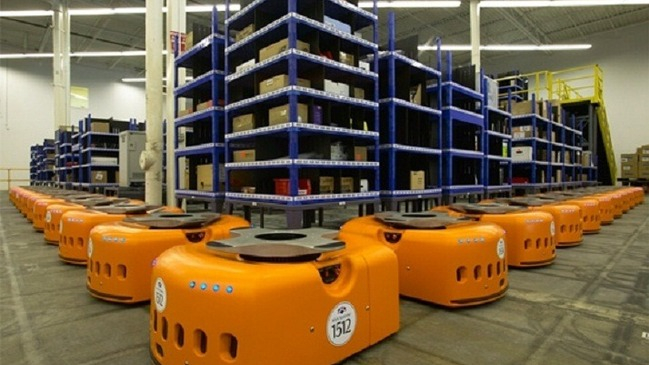
Amazon's Kiva robots work on the same principle but bring the stock to the order pickers and not the orders.
integration
WMS software also seems to be getting smarter all the time. If your in-house IT department can establish links with external information systems, you can receive information in advance from the supplier’s WMS regarding the exact composition of deliveries. Traffic delays are dynamically translated into priority changes in the order-picking route and an adjusted schedule for the staging areas to maximise the availability of loading docks.
And we are not even talking about the robots yet to come!
Robert van Ree - Senior Logistics Consultant at St Onge Company











