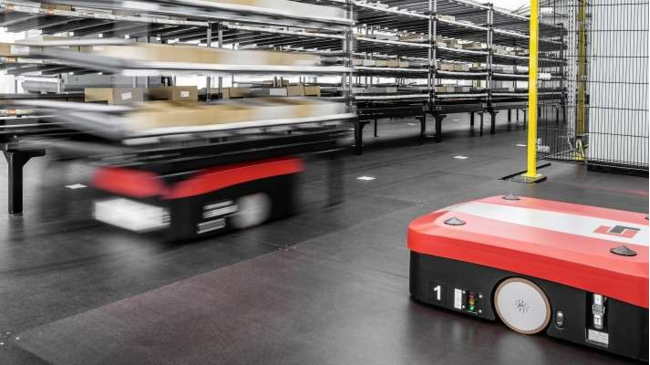
Increasing robotisation in logistics has not yet put the number of jobs in the sector at risk. An analysis of three million job vacancies by research firm Intelligence Group shows that demand for employees in logistics actually grew over the past year. Robots would still be too expensive for many companies.
For several years, people have been shouting that robots will take over the work of low-skilled employees in logistics and production. Minister Lodewijk Asscher, for instance, warned against robotics as recently as 2014. Certainly warehouse workers had to fear for their jobs, according to Asscher. "Robots are more reliable and cheaper. They are fast, never sick, work 24 hours a day, do not ask for a pay rise and are not represented by unions." However, it looks like robots are not going to take over paid jobs in the short term yet. In the Algemeen Dagblad, Ben Rogmans of labour market research firm Intelligence Group argues that there are some logical explanations for this. "For many companies, it is currently still too expensive to invest in robots, or the technology is not yet available. At the same time, there is extra work due to the recovering economy and so in those cases it has to be done by people."
Robot in development
Many robots now on the market are not yet able to match humans in certain aspects. For instance, robots cannot react well to unexpected situations or lack the finesse to grab certain products. However, the technology is developing rapidly. Last week, it was announced that UK supermarket Ocado plans to have a robot pick fruit and vegetables at its distribution centre. The robotic arm, which is currently being tested at the DC, looks like a bendable gripper with five fingers. Air pressure allows the hand to feel and grab the product. Such a hand could reduce food waste because the gripper is more careful than an average human hand.
Labour market in change
Rogmans thinks robotisation is going to affect employment in the sector in the long term, though. "It is much more likely that occupations in these sectors will change significantly. Take a tractor driver, that is pre-eminently such a profession that is going to be taken over by self-driving tractors. These are already driving around warehouses and they will eventually take to the road. That may take another 10 or 15 years, but that development will come.
According to Henri de Groot, professor of regional economic dynamics at the Free University of Amsterdam, it is important that workers continue to invest in retraining and upskilling to stay ahead of developments. "The idea that you work for one boss all your life is outdated," De Groot told AD. "It is obvious that we will have multiple jobs or completely different tasks. To dampen the negative effects of robotisation, we will have to invest in retraining and upskilling. In this, both employers, employees and knowledge institutions can take steps."
Editorial LogistiekProfs











