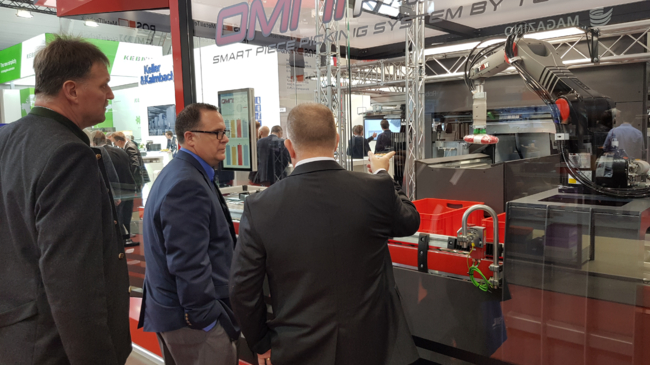
Without wishing to shortchange the latest state-of-the-art forklifts and other logistics savvy, the starring role at Logimat 2019 was for automated warehouse solutions. The labour shortage in the sector is playing into the hands of this development. A tour of the halls in Stuttgart provides the attached impression.
Logimat 2019 broke all records with an exhibitor count of 1,624 and a visitor count of almost 62,000. And they were not disappointed.
World premiere Black Line
AutoStore, for example, featured the world premiere of Black Line. The successor to the red R5 robot that was installed in 2005 and can be admired in some 300 storage systems worldwide, the award-winning system provides significantly higher picking and storage capacity. In this, the main role is played by a new robot, the B1. This is black in contrast to its predecessor and differs in a number of important ways. For instance, the self-driving trolley is equipped with a detachable lithium-ion battery. When it has a residual capacity of 80 per cent, the robot drives across the grid automatically to the charging station where the battery is changed. With a new, fully charged battery, the Black Liner can continue on its way. This is made possible by a patented BattPack technology where the robot picks up a fully charged battery itself when needed. Unlike the original red AutoStore robot which has an integrated lead-acid battery and therefore has to go to the side to recharge itself. In that process, the robot with a residual capacity of 40 per cent goes to shore after eight hours, after which the robot has to recharge for 20 minutes. The new Black Liner goes to shore after two hours with a residual capacity of 80 per cent, after which it continues its journey with a new li-ion battery. This new robot is thus in process 24/7 with an intended life span of six years.
The B1 does not pick up totes with gripper arms beside it, like the R5 Robot, but from below in its own 'body'. Due to its greater height, it can also carry, place and retrieve taller totes. Instead of up to 330 mm, the new bin is 425 mm high.
The lighter, new Robot B1 not only drives faster, it also reaches this speed earlier than before thanks to a new direct drive system. So says the manufacturer. Due to this technology, the acceleration speed is 75 per cent higher than that of the R5, according to AutoStore, resulting in an average capacity gain of 20 per cent over the R5. This also necessitates a faster workstation which AutoStore has also provided. This modular workstation consists of a picking module and buffer modules. Each workstation can have three to six buffer modules and process up to 650 totes per hour.

Lowpad small
Bleskensgraaf-based Eurotec launched the Lowpad in the logistics sector in September last year. This ultra-low AGV was initially developed for the horticulture sector as it fits perfectly under carts for that purpose, but the Bleskensgraaf-based manufacturer also saw potential for the logistics sector. E-fulfilment company Montapacking with ten branches and headquarters in Gorinchem was the first company to order several hundred of them last autumn, which it will put into use in phases until the end of 2020.
Eurotec decided at the eleventh hour to further peddle its success internationally as well and was therefore at the recent Logimat. Due to late booking, not on a regular stand but in the hall of the fair, with the advantage that everyone 'had' to pass by there too. And Eurotec also had a few novelties. Three to be precise. Besides the well-known 12.5-centimetre-high Lowpad with dimensions of 800 x 675 mm, the Lowpad Medium, it launched the Lowpad Small at Logimat. Sjoerd Visser, international sales engineer, says this one is mainly intended for the retail and postal markets. This is because the lift section of this Lowpad is so narrow that it can easily fit under postal trolleys and the narrowest roll containers. Because this section is so narrow, however, a solution had to be found for all control components. In the Lowpad Medium, these are fully integrated into the loading platform. This concerns the software that makes the Lowpad suitable for smart order processing. Visser: "Orders come in via the customer's WMS or ERP system and the software translates them into efficient orders for the Lowpad."
This is why the Lowpad Small has a different construction method in the form of a front and lift section, making it much like a pallet truck. Except that the lift section consists of one scoop instead of two. That front contains the complete controls. The complete Lowpad Small has a height of 650 mm and is further 1150 long and 600 mm wide. The dimensions of the lifting section are 800 x 240 x 105 mm, with the lifting section thus being another 2 centimetres lower than that of the Lowpad Medium. The lifting table can lift a weight of up to 450 kg 200 mm high.
In addition to the Lowpad Small, two more variants will soon enter the market with the Lowpad Large and the Lowpad Fork. The Lowpad Large, which will be commercially available approximately from mid-March, is an enlarged version of the first introduced Lowpad Medium, but is slightly larger at 800 x 1075 mm. At 650 kg, it can also lift more than the 450 kg of its smaller brother.
The Lowpad Fork, which is scheduled for market launch this autumn, is a variant of the Lowpad Small but has two forks instead of one. It is therefore specifically designed for pallets and can lift 1,000 kg instead of the Lowpad Small's 450 kg. As a whole, this Lowpad measures 1600 x 600 mm at a height of 650 mm. The lifting fork has dimensions of 1300 x 570 x 85 mm.

Award-winning 3D robot
French company Exotec Solutions' Skypod system won the award for 'Logimat's best product' in the order picking, transport, lifting and storage technology category. The Skypod system is a self-contained goods-to-man solution where a mobile 3D robot removes and places totes up to ten metres high from and into shelves. The robot arrives at the storage system as a self-steering unit, linking itself to the rack with a number of extendable grippers. The robots can then use artificial intelligence to move both horizontally and vertically to remove products up to 30 kg from the shelves and transport them to the order-picking tables.

Exotec Solutions only entered the market in 2015. It can now count several major e-e-commerce fulfilment companies among its customers. At C-Discount, bigger than Amazon in France according to its stand crew, it has a storage system with 50,000 totes and 40 robots as a reference. At fashion retailer Showroomprice, a system with 20,000 bins and 50 robots is running as a pilot. If that pilot runs satisfactorily at this e-tailer, the system will be expanded to 300,000 totes. A large French retailer, whose name Exotec is not allowed to disclose, is currently running a system with 200 robots. Exotec sells the robots as well as the racks and totes.
Automated pocket sorter
TGW showed with Omnipick the new pocket sorter with automatic infeed and outfeed. TGW targets fashion retailers as well as e-fulfilment and omni-channel fulfilment companies with the Omnipick. The system transports, buffers, stores, sorts and distributes clothes, shoes, electronic goods, toys and cosmetics in pockets. Via a matrix sorter, the pockets are arranged in the correct order towards output, so that they are delivered to the point of sale in the correct order. If necessary, garments can be transported between the pockets on hangers. Other products vidual products are placed in the pockets with a pick-and-place robot from the crates supplied via a conveyor. At the end, the pockets are emptied using a tipping station.
Managing director Benelux Hans de Sutter further highlighted the hanging garment as it will be found in Zara's new DC in Lelystad. It is based on the Stingray shuttle and, due to the required hanging garment transport, was designed especially for Zara.
Austrian TGW Logistics opened a Benelux office in mid-2016 because of two major projects it had won with Bol.com in Waalwijk and TVH. Managing director De Sutter says growth is well underway at TGW Benelux. A doubling of the workforce from 50 to just over 100 is planned for the next financial year starting in July.

Localisation without infrastructure
German scientific institute Fraunhofer IML had a novelty with an intelligent indoor localisation system for warehouse trucks, without the need for any infrastructure. The localisation of forklifts is based on artificial intelligence. A self-learning camera vision system with deep learning locates forklifts using recorded images of the warehouse ceiling and the characteristic features of each piece of ceiling. To do this, each truck is equipped with a camera that continuously films the ceiling and compares images with images already stored in the system.
This makes it possible to change the layout of a warehouse without changing the system. Indeed, nothing needs to be reconfigured in the system to ensure truck visibility when racks change location. In addition, the system is easily scalable for any hall area.
The stand crew explains that Fraunhofer developed this system specifically tailored for a new 30,000-square-metre warehouse to be built. According to Fraunhofer, the system is considerably cheaper than existing alternatives with, for example, wifi hotspots or RFID where costs can be as high as 2 or at least 1 million euros. But in any case much more expensive than the new system without infrastructure where costs are limited to 10,000 to 15,000 euros per camera per forklift truck. The exact cost in that case depends on the functionalities the camera has.

Lifter with grasshopper legs
Fraunhofer also showed a new unmanned transport system for boxes and crates with the Flexible Lifter for Intralogistics and Production (the FLIP). This includes it with a kind of grasshopper-like gripping arms and pulls them towards it for transport. At 560 millimetres, the transport system for boxes and crates is only slightly larger than the crate itself. Its advantage is that it can pick up crates that are very close together. The stand crew explains that the solution is mainly intended for companies where products come from very many lines that can be picked up with the moving robot.

High-speed UHF RFID scanner
Denso, part of the Toyota Group, showed at Logimat with the SP1, a UHF RFID scanner capable of scanning 700 tags per second up to eight metres away. The scanner can be linked to the business system by bluetooth via a smartphone. To do this, the QR Code on the SP1 is read with a smartphone. The new handhelds BHT-1700 and BHT-1800 can also be linked to the SP1 in this way.

Read also: Logimat: WMS can be even smarter











