Warehouse fit-out specialists
are working in droves to overcome the final hurdle on the path to full
warehouse automation: order picking. The trend that began last year at the
LogiMAT trade fair has been continued at this year’s event
with fixed and mobile robots for both item picking and case picking. Knapp won
won the innovation award on the first day of LogiMAT, but the competition is
not standing still.
With the Pick-it-Easy Robot, Knapp has developed a fully automated order picking station. The articulated-arm robot stands on a platform above the conveyor over which the storage bins pass. The gripper with small suction cups picks the right number of products from the bins and drops them into shipping boxes to the left and right of the conveyor. "The speed depends on the order pattern. If the robot needs to pick several items per bin, the speed can reach 1,200 picks per hour. If only one item is needed per bin, the speed drops towards 800 picks per hour," says Hans Overdijkink, sales manager at Knapp Benelux.
Crucial is the image processing software, which analyses the contents of the storage bin and calculates how the robot can best pick an article from the bin. Thanks to the different grippers, the robot can handle a large number of different items. "For a box of medicine, one suction cup suffices, but for a bag we use two and for a shirt, for example, four. Which gripper is needed for which item has to be indicated in the master data," says Overdijkink, who adds that the robot is already running in the Netherlands at Basiq Dental, a distributor of dental materials. "And we are not done with development yet. The next step is for the robot to stop dropping products and to carefully lay them down. That option should be ready in May."
Fill rate greater
Vanderlande also showed an articulated arm robot for item picking, mounted on a manual order picking station. Unlike Knapp's, this robot does carefully lay down the items in the shipping box. This does come at the cost of speed, which is around 600 picks per hour. "But because we carefully stack the products, the fill rate of the shipping boxes is a lot higher," says Remko van Gils, director food retail at Vanderlande.
To carefully pick and stack products, the order picking station has three cameras. The first analyses the contents of the storage bin, the second analyses the shape and size of the item picked by the robot, while the third analyses the best place in the shipping box. "This robot doesn't know in advance which products to pick. It only knows it has to pick something from the bin in front of it," Van Gils explains.
The combination with a manual order picking station allows robots and operators to work together. For example, if a robot has trouble with a particular product, it reports it and an operator can help it. "To do so, he does not have to open a gate first. As soon as an operator steps onto the order picking station's safety mat, the robot immediately reduces its handling speed."
ARM for collipicking
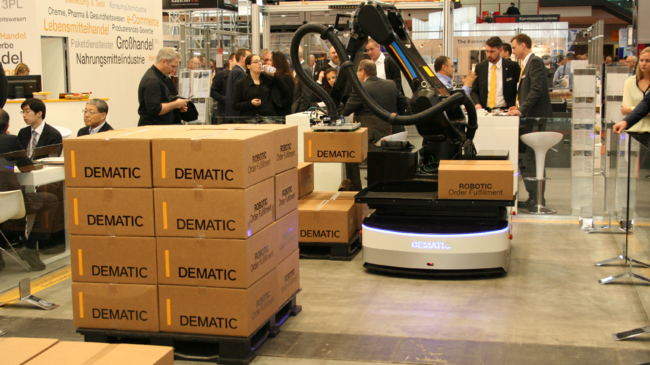
Opposite the Vanderlande stand, Dematic showed its own robot: a large articulated arm robot on an automated guided vehicle (AGV). This robot can drive along pallets and pick and take complete packages. Dematic has given the device a telling name: Automated Robotic Manipulator, ARM for short. The warehouse designer is thinking mainly of applications in warehouses with harsh working conditions for order pickers, such as in cold storage and freezer environments. "We want to be leading in innovation of unmanned transport systems. The announced integration with Egemin, which specialises in AGVs, shows this, for example. This robot also fits into that picture," states Barbara Wladarz, general manager of Dematic in Central Europe.
The vehicle on which ARM is mounted can carry 2,300 kilograms and travel two metres per second. For navigation, the vehicle uses optical sensors in the warehouse. The articulated arm robot can pick up packages weighing up to kilograms. In April, Dematic will start a test with ARM in America. The robot is not expected to be ready for market until mid-2018.
Robot from the cloud
Viastore also demonstrated a mobile robot, but this time for the inbound and outbound storage of totes. The robot, which resembles a stacker, was developed by Israeli company Caja Systems. Navigation is based on QR codes, which are attached to the ground at a distance of 1.2 metres. "That makes it possible to determine the position with an accuracy of one to two centimetres. That is sufficient for this application. The gripper that removes the bins from the racks is no longer needed," says Reuven Della-Torre, co-founder of Caja Systems.
Remarkably, the robot's control software is in the cloud. Via an interface, this software receives picking orders from the warehouse management system (WMS). Delle-Torre: "We want to offer a solution that allows companies to automate the inbound and outbound picking of totes without further modifications. That means a solution must be flexible and scalable. That is only possible with control software from the cloud."
Israeli Caja Systems, incidentally, is not the only party from outside Europe to enter this continent with innovative technology. Another example is GreyOrange, a company headquartered in Singapore and with its R&D centre in India. This company provides Kiva-like solution with robots that can transport complete shelving units to order picking stations. In India, Unilever uses this solution. Gopal Awasthi of GreyOrange: "We think there is a market for our solutions in Europe too. This is why we have now set up a branch in Hanover."











