1.5 million jobs will be lost in Europe
jobs in Europe if the logistics sector fails to adapt effectively to the robotisation of the
sector. In the early stages, people will still be needed to supervise and monitor the robots, but this will decrease over time. This is according to research firm Roland Berger.
It doesn’t seem to be causing much of a stir
, but according to the report ‘Of Robots and
Men – in logistics: Towards a confident vision of logistics in 2025’ by the
high purchase costs. Currently, robots in Western Europe cost between 100 thousand and
110 thousand euros per unit. This means a robot would cost around 18 to 20 euros
, whilst a logistics worker in the Netherlands costs 14 euros per hour.
The researchers expect this to change in the coming years. “In
the long term, with an increase in the robots’ productivity, a
longer service life and a fall in the purchase price, that difference
narrow and the economic advantage will lie with the robots. This is also because the cost of
human labour will continue to rise,” explains Didier Bréchemier of
Roland Berger. The consultancy firm expects a large
number of logistics solutions will come onto the market, with the purchase price
100,000 euros.
Unskilled jobs
In particular,
unskilled jobs are particularly at risk of being taken over by robots. The logistics sector can limit the number of
job losses if it prepares properly for the arrival of robots,
but even then, hundreds of thousands of jobs would be lost. The robots
are attractive to manufacturers and logistics service providers because
they enable them to achieve productivity gains. They are, in fact, four
to six times more efficient than humans. As a result, companies can reduce the costs
for material handling by 20 to 40 per cent, according to the experts.
Read also: The warehouse worker versus the robot: who wins?
The report also cites examples of robots that have boosted productivity
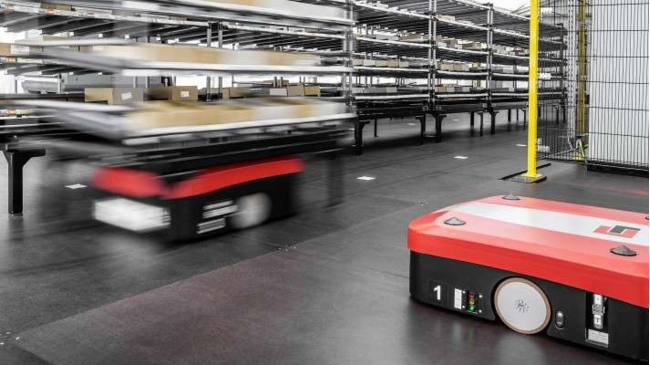
in distribution centres. For example, the Kiva – a system in which
trolleys navigate the warehouse autonomously, thereby delivering products to the
order picker, led to a productivity improvement of 20 to 40 per cent.
The Kiva costs between 25,000 and 35,000 euros and the payback period is
between 24 and 36 months.
Robots from Japan, Korea and China
According to the researchers, it is important that European companies and governments
invest in research to develop and support robotics. If
this does not happen, job losses in Europe will be even higher because
distribution centres will be staffed by robots from Japan, Korea and China.
Editorial LogistiekProfs











