In Part1, you read about how technical aids can increase safety when visibility on the warehouse floor is problematic. In this part, you will find five tools to help you manage the behaviour of your forklift drivers. Because you know: safety stands or falls with the behaviour of your people.
Limit speed
As mentioned, a safe working environment stands or falls with the behaviour of forklift drivers. Several systems are available on the market to help adjust that behaviour, for example when it comes to driving speed. Modern trucks already offer the possibility of reducing the maximum driving speed by default through software settings, but sometimes this is still not enough. In those situations, think of locations where many people work, using sensors it is possible to automatically limit the driving speed as soon as the truck enters the area. Further depressing the accelerator then no longer helps.
Mount shock sensors
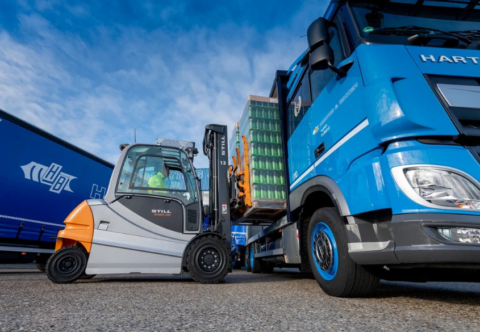
Going a step further is monitoring the driving behaviour of forklift truck drivers, for example by mounting shock sensors on their machines. These sensors record any unnatural shocks and transmit them, as well as data on driving speed and braking behaviour, to a fleet management system. Using the data from this system, team leaders or other managers can call their drivers to account for irresponsible driving behaviour. If drivers get out of line, this system can be used to set the truck to stop after three recorded shocks. No driver wants to experience that.
Authorisation of drivers
The same fleet management system also offers the possibility of regulating drivers' access to machines. This means, among other things, that only drivers with a reach truck certificate can be authorised to drive reach trucks. Those machines will only start if those drivers use their personal key or code, preventing unauthorised drivers from driving off.
Checking questions before starting
Before starting a forklift, a driver should take a lap around the machine to check its physical condition. It is a task that drivers are all too happy to forget. Nine times out of 10, this does not cause any problems, but the tenth time may be different. Therefore, there are lift trucks today that require drivers to go through a question path before the machine can be started up. That question path is different every time and is set up so that drivers cannot just click through. Besides, no driver wants to be caught off guard for overlooking a defect that caused problems later on.
Preventing collisions
One promising technology is real-time locating system (RTLS), a system that allows the exact position of all moving objects in a hall to be determined. If both forklifts and pedestrians are tagged, this system can immediately raise the alarm if two objects approach each other closely and a collision is imminent. It is possible to warn drivers and pedestrians with light and sound signals, as well as to stop the truck. RTLS has been around for a long time, but with the advance of robots and drones, the technology is rapidly improving and the possibilities are rapidly increasing.