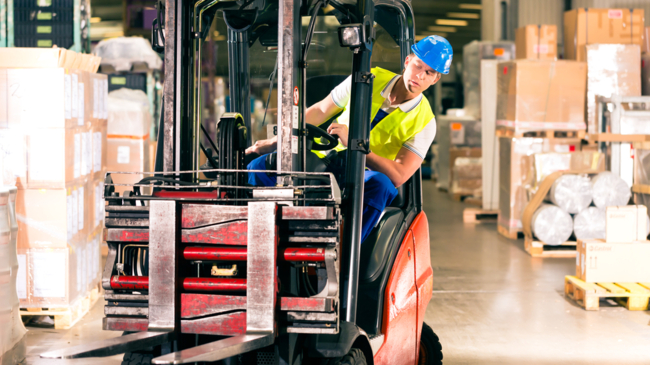
Even with the safest forklift in the safest warehouse, accidents lurk. Safety is entirely determined by the behaviour of the man or woman sitting on the forklift. How do you make sure a driver drives safely? The recently launched Safe and Healthy Warehouse Code should help organisations improve their safety culture. This culture has a major impact on employee behaviour.
Companies often tend to think that providing knowledge is enough to influence employee behaviour. "If we just stress the importance of employees changing their behaviour, they will naturally start showing the right behaviour. If that fails, we need to repeat the message again or in a different way."
Nothing could be further from the truth. Knowledge is important, but behavioural change requires more. Steven Gudde of Olympia Uitzendbureau referred to research from behavioural psychology during the introduction of the Healthy and Safe Warehouse Code. This research shows that knowledge only determines 15 per cent of employees' behaviour. The employee's self-image and social norm play a much more important role in changing behaviour.
Belonging to the group
On the theme of self-image, Gudde emphasises belief in one's own ability. Am I capable of performing the desired behaviour? As a forklift driver, have I mastered safe driving? Is it possible for me to meet my manager's expectations? Do the answers to these questions sound negative? Then employees are a lot less likely to adjust their behaviour.
The social norm Gudde talks about is about the group a person wants to belong to. How does the group feel about the behaviour expected of me? This would explain why temporary workers are more often involved in accidents. "Do you (un)consciously approach your own employees differently from temporary workers? Then it is difficult to get them to exhibit the same behaviour."
Cool boss
An important aspect is the working relationship managers have with employees. This relationship has three components:
Economic relationship: is the employee getting a fair reward for the work done?
Legal relationship: does the employee have a permanent contract, timely contract or zero hours contract?
3. Psychological relationship: how do manager and employee interact?
According to Gudde, we often focus on the first two components, whilst the third is actually becoming increasingly important. “To change employees’ behaviour, we need to work on that psychological relationship. Why do people start working more safely? Because they think you’re such a great boss. Or because they want to look after their colleagues.”
The Safe and Healthy Warehouse Code also addresses the working relationship. Here it talks about connectedness. Indeed, employees need to feel connected in order to perform optimally. Connectedness with the employer, colleagues and the work environment ensures that every employee sees safety as a personal interest.
This is where the role of the manager plays a major role. In a nutshell: the manager shapes the company. The manager must ensure a culture where people feel connected and put safety first. The code cites PhD research by Jelle de Vries, associate professor at the Free University Amterdam. "If you want to have an efficient and safe warehouse, you have to set a good example yourself and be able to inspire and make employees aware of the dangers of their work."
Tom van Blom - Internal transport expert











