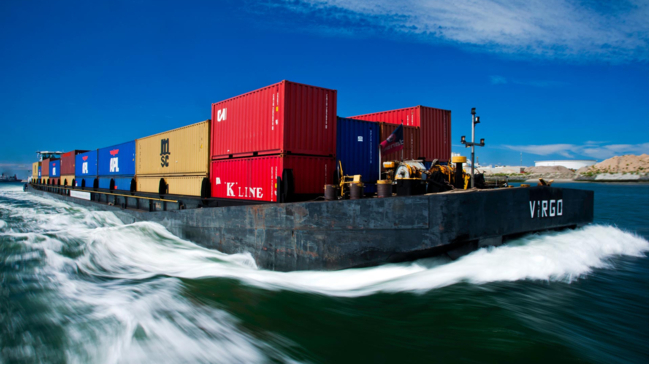
Transport via northern European ports is not only cheaper than via southern European ports, it is also more sustainable. This emerges from research by Panteia commissioned by the Port of Rotterdam Authority and Deltalinqs.
The containers in question are those destined for southern Germany, the Czech Republic or Poland. The route via northern Europe is more sustainable despite the fact that container ships between Asia and Europe always pass through the Suez Canal, making the shipping route to southern ports such as Koper, Constanta and Genoa shorter.
Larger ships
Ships sailing via northern Europe therefore have to travel a longer distance. Yet this route is said to be more sustainable. The reason for this is the size of the ships. Northern European ports are visited more often by large ships than southern European ports. A ship with a capacity of 20,000 TEU (unit size for containers) emits much less CO2 per container per day than a ship with 10,000 TEU. This can save up to half of CO2 emissions, according to the researchers. Logistics chains thus become more sustainable if they make more use of large ships.
Legislation for sustainable logistics
Panteia also argues that a wide application of ICT could make logistics even more efficient and increase the load factor of containers and transport modes. This could reduce CO2 emissions by 5 to 10 per cent. The study therefore advocates legislation that could make logistics even more sustainable. For example, by encouraging the use of alternative fuels, and by focusing on sustainable hinterland modes or ICT solutions that can lead to sustainable logistics.
Editorial LogistiekProfs
Stay up to date
Sign up for the newsletter and receive the latest news, trends, innovations and developments from the sector.











