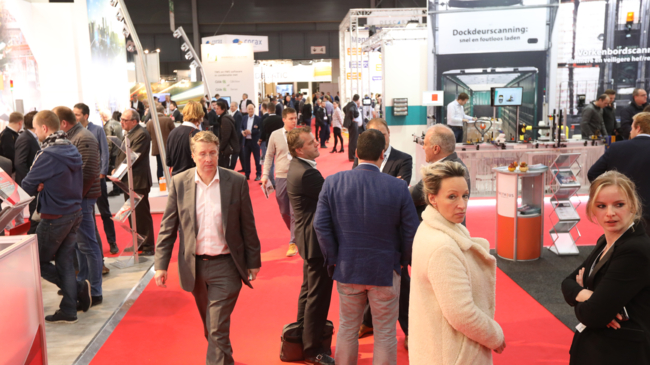
Robot suppliers are busy during this Logistica. Many companies have woken up to all the stories about robots and are coming to the fair with questions about application possibilities. Some companies are already advanced with their ideas and know exactly what they want, others are still in the orientation phase. "Many companies are still a long way from being ready to apply robots," he says.
Smart Robotics is at the Scala Pick in hall 4 with an elegant robot arm specialising in item picking. The robot is attracting a lot of interest. "Every day we get a call from a company wanting to know what the application possibilities are. We also get a lot of enquiries at this fair. However, many companies are not yet ready to deploy robots," says Heico Sandee, co-founder of Smart Robotics.
Sandee refers to the companies where employees combine many tasks. They select the right box size, put in the collected items, add padding and shipping documents and tape the box shut. "It is difficult to automate so many different tasks. It is different at the larger warehouses, which often already have a process that is broken down into several steps. Then it is a lot easier to deploy robots."
Item picking and palletising
Smart Robotis started two years ago with a team of two people. Now the company already has 25 employees, putting five robots on the market every month. That the company has potential is underlined by Vanderlande's minority stake in Smart Robotics. Vanderlande will sell the robots to large logistics companies. "In total, we now have about 65 robots working. Item picking is an important application. Our robot arm picks one item from a bin of identical items and stacks them neatly in a box," says Sandee.
Remarkably, palletisation is an even more important application: a process for which articulated-arm robots have been used for decades. "But those are robots where every movement has to be pre-programmed. If our robot needs to stack a new product, all the operator has to do is enter the dimensions on the control platform. That platform then shows a number of possible stacking patterns, from which the operator chooses one. Then the platform itself calculates which movements it needs to make to achieve that stacking pattern. In that intelligence lies our added value."
Learning instead of competing
The Logistica has more robot suppliers. A little further down in hall 4 is Magazino, a German start-up with a robot that independently drives along shelf racks to pick shoe boxes. Also present in that hall is Gibas, which supplies the same robots as Smart Robotics. "Gibas is the Dutch importer of these robots, we buy them from them. We work together a lot, as with Magazino. The market is big enough for all of us. We can develop the market faster by learning from each other than competing with each other," Sandee says.
While Smart Robotics focuses more on order picking processes in distribution centres, Gibas' focus is on the intersection of production and logistics. "We see a lot of demand for our robotic arms, but even more for our AGVs. Customers deploy them for supply or removal from production lines. Operators in the warehouse, for example, place the finished product in a bin, which the AGV takes to the right production line. Operators can indicate themselves where the AGV should go," says Theo Drijfhout of Gibas Automation.
Flexibility through intelligence
As with robotic arms, AGVs are distinguished by the added intelligence that makes them flexible to deploy. No fixed infrastructure in the form of reflectors on the wall or markings in the floor is needed. "The AGV can easily learn a new route by scanning the environment with its sensors. Based on this, the control platform creates a digital map, in which the operator can indicate a stop. The AGV then drives there independently," says Drijfhout.
According to Gibas, the big advantages arise when different techniques are combined. Drijfhout: "We recently started supplying a compact, automated storage system with totes in the Netherlands. Our AGVs can automatically transport these containers to the production line. If necessary, the robot can be used to stack items from storage bins in bins in front of the production line. In the coming years, we are going to see more and more applications like that."











