There are several trends playing out in logistics that can also be seen at LogiMAT. They provide greater flexibility, scalability, quality and continuity in operations and enable new payment models. In this article, four trends with examples from the exhibition floor.
Trend 1: reducing downtime
Along with the level of automation, the risks in warehouses are also increasing. If an automated storage or order picking system is down, no order goes out the door. Warehouse engineers have long anticipated this with the option of managing systems remotely. Service engineers can log in via the internet and see where the fault is. Thanks to the possibilities of big data and analytics, they are now taking the next step: condition-based maintenance. By recording and analysing system performance and sensor data, the ability to predict when systems will fail is growing. Warehouse operators can anticipate this by scheduling preventive maintenance.
Swisslog received an innovation award at LogiMAT for its Condition Monitoring concept. Commenting on the award, Christian Baur, COO of Swisslog, said that Swisslog's aim with this concept is not just to reduce system downtime. "By applying modern analysis techniques, it is possible to develop the rigid, project-driven approach in intralogistics towards a service-oriented approach with pay-per-use payment models."
Trend 2: modular constructions
The design of automation systems in logistics is still often a matter of customisation. For each new project, warehouse fitters go back to the drawing board to design a unique system with a unique controller. Increased use of modular design techniques drastically reduces the time required for design, production and installation of systems, with little or no loss of functionality.
LogiMAT shows several warehouse equipment manufacturers who have put modular design into practice. One example is Austrian steel specialist Voestalpine Krems, which has developed a modular storage system for tyres and wheels with Cubiqo. The storage system consists of different building blocks, which can be placed on top of and next to each other. "This reduces installation time, but also design costs. We don't have to keep calculating how much load capacity a system can handle," says an employee of Voestalpine Krems.
Trend 3: plug-and-play
Conveyor systems were once called building-based systems. That designation says it all: they were rigid and inflexible. Those times are changing. More and more suppliers of conveyor systems apply modular design principles and also implement them in the controls. This leads to plug-and-play conveyors, which no longer require long programming and testing processes. An additional advantage: the arrangement of conveyors is much easier to adjust than before. Sliding the various modules around and plugging them in again is enough to create a new configuration.
One player at the forefront of these is Next Intralogistics. This warehouse furnisher supplies the FlexConveyor, a modular system developed together with the Karlsruher Institute of Technology. This enables completely new financing models such as renting and leasing conveyors. Short rental periods are also possible. "Only use conveyors when you need them, for as long as you need them," is Next Intralogistics' motto.
Trend 4: get it right the first time
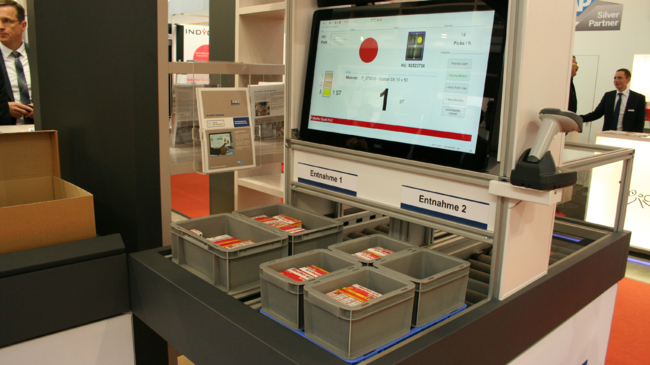
Nothing more frustrating than a service engineer waiting for parts on the other side of the world, only to discover that the wrong ones have been sent. A customer of German software provider IGZ wanted to prevent that. 99.9 per cent error-free orders is not enough, with less than 100 per cent the customer was not satisfied. That led to a new technology for controlling order picking processes: pick by motion. Cameras above the picking station closely monitor which bin an order picker takes something from and in which shipping box that item is put back down. "Order pickers do not have to scan and therefore have their hands free. Pick-to-light would also have been an option, but then the order picker would always have to press a button. That is now no longer necessary," states Markus Wenning, vice sales director of IGZ
Marcel te Lindert - Journalist logistics & supply chain management











