Three factors are crucial for a safe warehouse: technology, procedures and people. The technology and procedures are often quite simple, but the people factor is difficult to control. The solution of the Safest Warehouses in the Netherlands: invest more in employees. An additional advantage: this increases the attractiveness as an employer in this tight labour market.
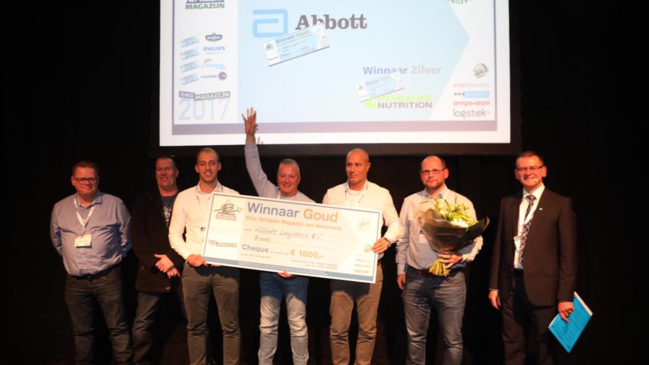
Safety is a fundamental working condition. That's a statement from Breda-based Abbott Logistics (pictured), the warehouse awarded gold during the election of the Safest Warehouse in the Netherlands. Indeed: with logistics staff becoming scarce, it is more important than ever to create good working conditions. A safe working environment in which warehouse workers dare to trust makes an important contribution to binding and retaining people.
The good thing is: this knife cuts both ways. For a safe working environment, it is necessary to invest in the employees. After all, it is their behaviour that largely determines whether a warehouse is safe or not. Investing in people contributes to their personal development. It boosts employees' self-confidence and increases employee satisfaction. That too helps retain people for the warehouse.
The Safest Warehouse election - which took place during the recent Logistica trade fair - provides some important lessons. They make it clear that investing in people pays off.
1 Safety does not come by accident
This is the motto of Herbalife, which won silver at the election. The motto makes it clear that a warehouse can only be safe if structural attention is paid to this topic. This is lacking in many companies. They only take action when an accident occurs. By then it is already too late.
The first tip: respond not only to accidents, but also to near misses. In a warehouse, it is like on the road: very often an incident ends well just in time because someone pulled the wheel or applied the brakes. Take such warnings seriously. Discuss them with employees, analyse the cause, brainstorm on possible solutions and get to work on them. This increases team solidarity and safety awareness. Besides: chances are that employees have experienced similar incidents before and will come up with good solutions.
2 Make no distinction between permanent and flex workers
The expert jury praised Herbalife because permanent and flexible employees are treated in the same way. This is different in many companies. Flexible employees - 'they'll be gone in no time anyway' - are not given the same guidance as permanent employees. In other words, they are not considered full members of the team. This consciously or unconsciously impacts the behaviour of these 'second-class workers'. They have less self-confidence and are less motivated to work safely and disciplined.
Research by TNO commissioned by the Stichting Arbo Flexbranche (STAF) shows that flex workers are actually more often involved in accidents than permanent employees. Companies that encourage temporary workers to work safely and listen to their improvement ideas are significantly safer, according to the figures.
3 Give newcomers a coach
We would all like that: new employees who after one day are as skilled and disciplined as the permanent employees who have been working in the warehouse for decades. But that, of course, is not the case. It takes time to get to know a warehouse - where dangers are sometimes in a small corner - well. It also takes time to learn how to drive a forklift or reach truck. Even an 18-year-old kid is not a good car driver after one driving lesson.
Yet many companies treat their newcomers as if they were superheroes. They may receive guidance for the first day, but then leave them completely outlawed. This can be done differently. Give newcomers a coach or buddy who guides them over a longer period of time. This does not have to be a supervisor who constantly watches them, but, for example, an experienced colleague who regularly asks how things are going and gives them instructions if necessary. If a bond of trust develops between a newcomer and his buddy, it creates space to discuss positive and negative experiences.
4 Ensure good managers
Nothing is more damaging to the safety culture than a manager who himself flouts all protocols. Is a manager walking through the warehouse without safety shoes? Does he not adhere to clearly marked walking routes? So why should employees?
The influence of warehouse managers is even greater than that. This is shown by insights from social psychology, among other things. Time and again, it turns out that telling employees to work safely is not enough. Many employees know this themselves, yet they far from always do so. This is because other factors come into play, such as the employee's self-image or the social norm in the warehouse. 'Am I such a good forklift driver that I can work safely? Am I not a wimp if I follow the rules exactly?' These are mindsets that can get in the way of working safely.
Managers such as warehouse managers and supervisors can work on this by ensuring a good culture and a good relationship with employees. To do so, however, they need to have the right competences. Or as Steven Gudde of temporary employment agency Olympia once said, "Why do people go to work more safely? Because they think you're such a cool boss. Or because they want to be economical with their colleagues."
Read also: These are the safest warehouses in the Netherlands











