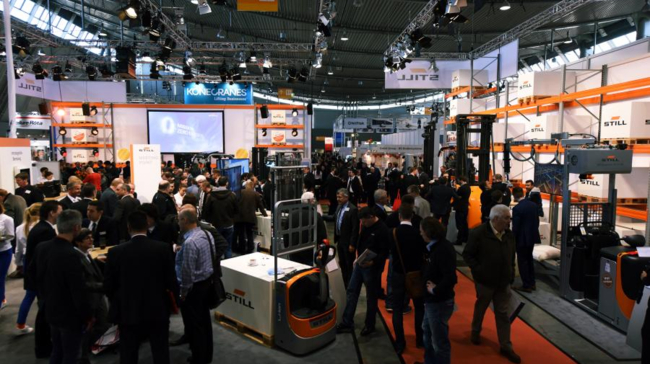
There were
There were plenty of them at LogiMAT, the popular logistics trade fair that
took place in Stuttgart last week. The common thread running through all these
innovations is automation, but specifically in combination with speed and
flexibility. LogistiekProfs has compiled a list of five notable innovations.
1 Order pick truck follows closely
Most of the attention at the trade fair was on the iGo neo CX 20, Still's order pick truck that follows its owner like a lapdog on its way through the warehouse. This truck, according to the German forklift manufacturer, saves 30 per cent of time, simply because the driver does not have to get on and off again and again to move the machine sometimes just a few metres away. Competitors such as Crown and Jungheinrich therefore developed a remote control that allows the driver to move the order-pick truck a few metres, but Still no longer needs that either. The secret lies in a laser system that continuously monitors the driver's position. If the driver walks a few metres away, the truck also starts moving, and if the driver stops, the truck brakes elegantly until the pallet carried on the forks is directly in front of the correct picking location. If there is an obstacle in the aisle, the truck will find its own way around it. An ideal colleague, in other words.
2 Vanderlande lets it hang
Vanderlande showed its own system for hanging goods at the fair, filling a gap in its portfolio. This system, named Airtrex, comes from the womb of Smatec, a Bielefeld-based start-up that has been part of Vanderlande since October 2014. The distinctiveness of Airtrex is not so much in its functionality, but much more in its design. For example, Airtrex has only 3,000 unique components, while competitor systems easily contain 7,000 to 10,000. This means that the system is faster to install and requires less maintenance, while the stock of spare parts can be limited. Another advantage is that Airtrex is not driven by a chain like other systems, but via friction: two wheels, driven by an electric motor, push the suspension track forward. A chain has two major disadvantages. First, the length of a chain is limited, requiring complicated transitions between the parts driven by different chains. In addition, oil is needed to lubricate the chain, which is not a convenient combination when combined with clothing. Vanderlande is currently working on a variant of the Airtrex that can be used as a pocket sorter. This will also make this system suitable for use in e-commerce warehouses.
3 Sorting pallets by loading sequence
Large parts of the warehouse can be automated today, but on the shipping floor it often still remains a struggle. Many square metres are often needed to get pallets ready for transport. Kardex has developed a compact solution with the MSequence. Pallets are temporarily buffered in racks placed in front of the loading doors. A special racking operator picks the pallets from the racks in the correct order and places them on one of the roller conveyors running towards the loading doors. The system has two standard versions: one with 184 pallet spaces, good for 5.5 trailers, and one with 272 pallet spaces, good for 8 trailers. In the first variant, the racking control device achieves 64 double plays per hour, and in the second, 57 double plays. According to Kardex, the system is designed on the plug-and-play principle and the delivery time does not exceed 22 weeks.
4 AGV that follows the line
There were a particularly large number of automated guided vehicles (AGVs) at LogiMAT. The new variant from Bito Systems excels in ease of implementation: sticking a red tape on the floor is enough to make the Leo Locative follow a course. Change the tape and the vehicle shifts its course. By sticking a strip of 2D barcodes at the end of the route, the vehicle gets its commands and knows whether to drop off or pick up a bin. For this, Bito's AGV does not need a wifi network or connection to the WMS. The question is how long the tape lasts in an environment where many people also walk around. However, anyone who regularly has to set up temporary processes with a highly repetitive character may very easily automate a number of transport movements this way.
5 Parts in the carousel
German company TWI has developed a fully automatic rotating carousel in which 240 bins with parts of up to 400 millimetres fit spread over eight levels. This tower, which can accommodate a total of two tonnes, has a vertical panel with a display for each level showing how many pieces are needed from the pre-turned bin. With an order pick trolley, equipped with pick-to-light displays, it is possible to distribute the parts among 20 shipping boxes. Once a pick is attached, the carousel rotates again for a bit until the next pick location is in front. Completely new techniques such as the carousel, pick-to-light and put-to-light are obviously not new, but in this combination, the SP-AERO could be quite interesting for some companies with many small parts.
Marcel te Lindert - logistics and supply chain journalist











