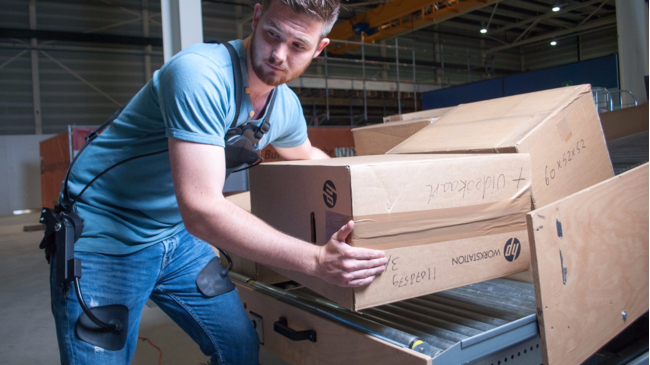
VIL is launching a study on the usability of exoskeletons in the logistics sector. The aid would give logistics workers more strength and stamina.
Exoskeletons are wearable robotic suits that support the human body. This can come in handy when lifting heavy objects. The exoskeleton reduces the physical load in manual operations such as order picking, packing, loading and unloading, allowing older workers to be used for longer.
Passive and active exoskeleton
Exoskeletons can be divided into two categories: the passive exoskeleton and the active exoskeleton. The passive exoskeleton redistributes human strength, putting less strain on certain parts of the body. Active exoskeletons are motorised, reducing the load on the body.
VIL will test both types in practice and survey the different exoskeletons and their cost. With the practical tests, VIL wants to get clear to what extent the suits are ergonomically supportive and whether their use promotes productivity.
Twelve participating companies
The 'Exoskeletons for Logistics' project will start on 12 December 2017 in cooperation with 12 companies. Participants are: Atlas Copco, bpost, Colruyt, Conway, Danone, Delhaize, Gates Distribution Center, H.Essers, Honda Motor Europe Logistics, Limburg.Net, Oesterbank and Sortbat.
"We want to gain experience with an exoskeleton that supports the employee's strength," says Roeland Motmans of Colruyt Group. "Within Colruyt Group, we still have a lot of physical work. The aim is to reduce or shorten sick leave. A first approach is from reintegration. People who have been out of work for a long time because of their back or shoulders may be able to resume work more quickly if temporarily supported by an exoskeleton. A second approach is to look at physical workstations where improvements are not obvious. An exoskeleton could then possibly be used preventively, when other measures fail."
Image: exoskeleton from Laevo











