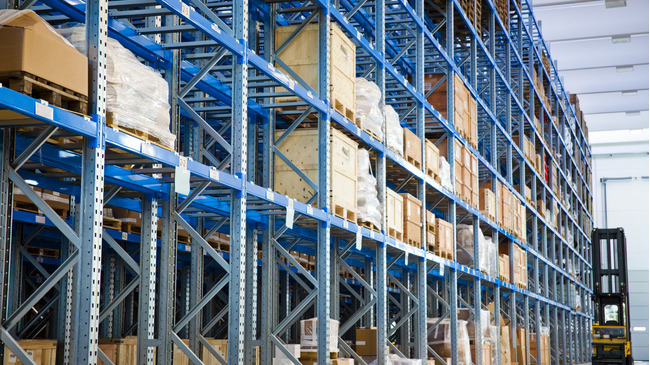
New warehouses are rapidly being built again in the Netherlands and it will not escape anyone's attention that the 'block boxes' are getting bigger and bigger. Is this because of a planned increase in storage or is the need for flexibility playing an ever-increasing role?
The question of how much flexibility to incorporate comes up fairly early on during the design process. And the question is legitimate because flexibility in the logistics context means building in extra space to cover uncertainty and is sometimes a 'show stopper' for mechanised storage systems.
And that flexibility usually costs extra money is obvious. To make trade-offs and attach a number to them, you will first have to make it clear what you are talking about. Is it only about uncertainty in future product dimensions and the corresponding storage, or will the existing B2B operation get another E-fulfilment brother, whether or not intended for third-party logistics.
Unknown products and volumes
Online channels with constantly changing and increasingly complex requirements demand an ever-faster response from businesses. Revenue models must be able to be adapted quickly and the corresponding product ranges introduced rapidly. As no one can predict future product dimensions or the required number of days’ stock, pallet and shelving racking will need to be provisioned with more capacity than historical calculations suggest.
But storage space is not the only flexibility criterion. Promotions are increasingly causing huge spikes in daily orders and are also often used as 'traffic generators' for other products. Narrow aisle storage systems, intended for higher storage densities, then no longer suffice because they cannot handle the higher throughput. Not for nothing has Amazon set up many of its warehouses with manual floor operations for picking boxes from pallets. It is the maximum form of flexibility because they can accommodate every new item in such a concept. During seasonal peaks, they can quickly increase the number of order pickers to still deliver on time. Productivity loss due to increased walking distances is compensated by smart, home-built WMS algorithms that can very dynamically assign tasks to order pickers based on their location.
’s cost breakdown
A conscious choice for flexibility is therefore the result of a clear vision and is rarely called into question afterwards. However, a qualitative and quantitative assessment will need to be carried out to determine how much it should cost.
What is it worth to you to introduce 100 new items of unknown volume every week and be assured of a pick location? Do you opt for extra loading docks or extra siding behind each door to handle the peak of trucks? Do we opt for ranges whose products can continue to be stored in bins in a Shuttle system or do we not want to be limited by that?
All questions that need to be answered one by one in order to make conscious choices and determine the final cost of the desired flexibility.
Robert van Ree - senior consultant St Onge Company











