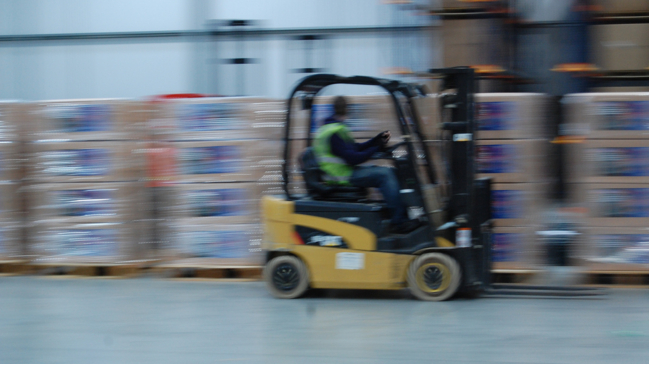
Lift and warehouse trucks are darn useful tools in logistics, just a pity drivers are needed. Drivers cost a lot of money, get tired, make mistakes and cannot be programmed efficiently. Remarkably many exhibitors at LogiMAT therefore showed solutions that reduce or even eliminate the role of forklift drivers. They may soon not even have to get out of bed to do their work.
Moving a truck around unmanned was already possible, but it was striking that at LogiMAT in Stuttgart, every forklift supplier prominently displayed its capabilities in this area. Developments in this field are moving fast, rapidly increasing the possibilities and reducing the costs. This makes the use of unmanned lift and warehouse trucks increasingly interesting, especially for companies operating 24 hours a day. Many specialists in automated guided vehicles (AGVs) therefore also showed off their capabilities, from large vehicles for handling passenger cars to new, small slick-looking ones for transporting totes or boxes.
For those for whom all these unmanned vehicles are still a step too far, lift truck manufacturers offer all kinds of intermediate solutions that reduce the human factor. One example is Still's new order picker truck, which won an innovation award at LogiMAT. This truck closely follows the order picker down the aisle, eliminating the need for them to constantly get on and off. A long-standing technology is Jungheinrich's navigation system, which ensures that narrow-aisle trucks automatically drive to the correct storage location so drivers no longer have to search and manoeuvre. Still and Jungheinrich claim 25 to 30 per cent time savings with this kind of solution.
Similar advantages offered by the indoor positioning systems present at the show. Zenotrack is an Austrian company, acquired by the Bosch Group, which has developed a positioning system that has already been installed on 600 vehicles. It is an optical system that, like an optical mouse, can determine the exact position based on the ground structure. The system can be used to prevent searching for goods, automatically opening doors or adjusting speed to the environment, but also, for example, to generate heatmaps to identify bottlenecks in goods flow movements.
German company IdentPro has developed a positioning system based on laser technology. A laser on the back of the forklift continuously scans the environment at an angle of 190°, allowing the position of the truck to be determined with an accuracy of 10 centimetres. Like Zenotrack's system, the advantage is that users do not need to install markings, reflectors or antennas in the building. Another advantage is that both systems generate new data that provide opportunities to improve processes. Zenotrack is therefore already in talks with SAP and some forklift manufacturers to link the data from the positioning system with the data from warehouse management and fleet management systems to generate new insights.
Perhaps the biggest advantage of these indoor positioning systems is that forklift drivers no longer need to scan. By fitting the forklift forks with a height sensor and a load sensor, the system knows exactly at which coordinates a pallet has been put away. Only on the very first entry of the pallet into the warehouse might it be necessary to identify a pallet with a scan, but after that, every movement through the warehouse can be recorded to the nearest ten centimetres. This reduces the risk of errors and increases productivity.
These kinds of systems may also make it possible to realise an idea Toyota plans to present at CeMAT: remote control of forklifts. According to Toyota, it is possible to largely automate the work of forklifts such as driving back and forth between two locations, but often a driver is still needed to perform certain complex operations at the starting or finishing point. If forklifts are remotely controlled and equipped with cameras, that could be a driver sitting in the office operating three or four trucks at the same time. This idea is reminiscent of the container cranes at APM's terminal on Maasvlakte 2, which are also operated remotely from the office. If this concept is also realised in the warehouse, forklift drivers will no longer even have to get out of bed.
Marcel te Lindert - logistics and supply chain journalist
Always stay informed
Sign up now for the LogistiekProfs newsletter and receive the latest news, trends and offers.
Image:Mark Hunter - License: CC











