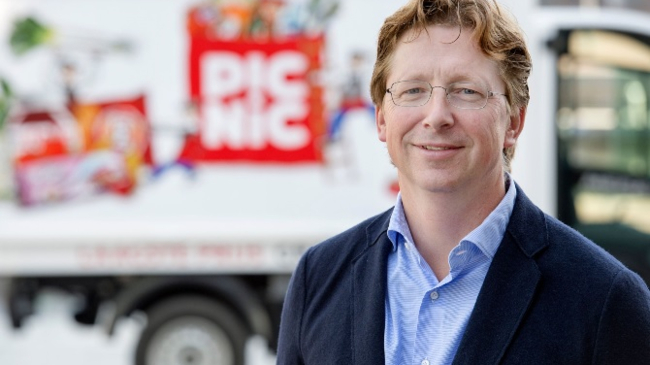
Until the arrival of Picnic, few people seemed to believe in online grocery shopping. Reasons: too expensive, consumers have to wait a long time for their orders and the ordering process is clumsy. Frederik Nieuwenhuys and Joris Beckers saw it as a challenge to remove those obstacles. During the Logistics & E-commerce Business Day, Nieuwenhuys explained which solutions Picnic came up with to put online grocery shopping on the map after all.
App instead of desktop
Picnic's founders initially developed a desktop site, but eventually decided to switch to a mobile application. It would be easier to use. "The whole family can download this app. In the morning, when the children see that they have run out of sprinkles, they put a new pack of sprinkles in the shopping basket. Mothers can order it in the evening along with the other groceries," said Nieuwenhuys.
Predictable delivery time
Picnic's delivery vans do not drive into the neighbourhood for every order separately. They visit a particular neighbourhood up to three times a week. Consumers can choose one of these times. The time slot is one hour. In the morning, customers receive a text message indicating the 20-minute delivery time. Through the app, customers can see exactly where the driver is during the day. So consumers do not have to stay at home for hours to receive their order.
To predict delivery time as accurately as possible, Picnic uses systems that plan in great detail. For instance, they take into account when the delivery driver has to climb stairs, or when a customer has ordered something for the first time. In the latter case, extra time is calculated so that the delivery driver can stay longer to have an introductory chat.
Fresh delivery drivers
Picnic also wants to distinguish itself with its delivery drivers. After all, they are the face to the customer. On this, the co-founder says: "All our delivery drivers are young boys and girls with a fresh appearance. Exceptionally, 40 per cent of our delivery drivers are women. You don't see that anywhere else." The online super strives to send the same faces to the same doors. "This creates a bond between delivery driver and customer," it says.
Customer at the wheel
"All gates are open," claims Nieuwenhuys about communication with the customer. The online super wants to know exactly what consumers want. That's why it decided to start talking to its customers. "We spoke to our first thousand customers face-to-face. We rented rooms and asked attendees for feedback." After delivery, customers are asked to rate their order via the app. The feedback rate is 80 per cent, according to Nieuwenhuys. Customers can also indicate in the app if they are missing any products. Customer service also aims to answer all questions within three quarters of an hour.
Expansion across the border
Picnic has also received high praise abroad with this concept, reveals Nieuwenhuys at the trade day. "There is interest from all over the world. We are in talks with parties from Turkey, Russia, America." Yet expansion across the border is not at the top of the online super's priority list. "We want to scale up in the Netherlands first. We have just settled in Utrecht. Apeldoorn and Almere will probably be next." Asked whether Picnic is already profitable, the co-founder does not give a concrete answer. "First of all, let me say that costs come before benefits."
Editorial LogistiekProfs











