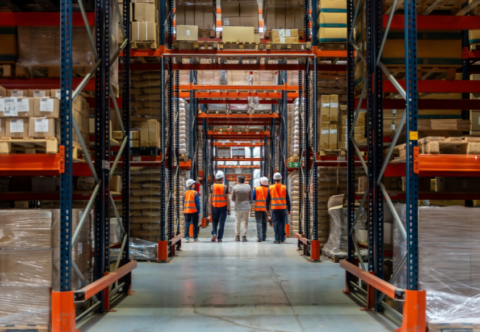
The average age of forklift drivers in the Netherlands is over 50. This is according to the National Survey for Forklift Drivers from BLOM trainings. The poll of 1,351 forklift drivers shows that the pool of forklift drivers is ageing rapidly. A possible solution lies in attracting female forklift drivers.
During the previous edition of the 2018 National Survey of Forklift Drivers, the average age was only 44. The high rate of ageing is forcing companies to think twice, BLOM argues. With age, the risk of physical complaints increases. In the longer term, ageing may also have implications for business continuity. Can young people still be encouraged to work as forklift drivers?
Another striking result is the decline in the number of women. Between 2015 and 2018, the proportion of women on the forklift doubled from 6 to 12 per cent, but in the past two years the percentage has dropped again to 8 per cent. There are opportunities there for companies struggling to find good forklift drivers, says Maarten Dullaert, commercial manager at BLOM training: "Female forklift drivers tend to be more precise and cautious. This benefits safety. But the falling percentage of women raises the question of whether the working environment is female-friendly enough."
Critical of supervisor
In the Netherlands, 646,000 people have a job in logistics. Together, these contribute as much as 53 billion euros to the Dutch economy. That would not be possible without the forklift drivers who are hidden behind the big grey walls on industrial estates quietly doing their work. The National Survey of Forklift Drivers paints a portrait of all those forklift drivers.
That portrait shows that forklift drivers have an average of 18 years of experience on the forklift. In more than half of the cases, they have a permanent contract for 35 hours a week or more. They are proud of the company they work for, reasonably satisfied with their job, but critical of their manager. Most are satisfied with their salary, although respondents' answers show that differences in salary are wide.
Professionalism on the rise
The survey also shows that professionalism in the forklift driver profession is growing. More and more forklift drivers have a certificate that is valid for five years. More than half of the companies are making provisions to also keep competences high in the five years between each certification, ranging from extra training to e-learning.
In addition, almost all drivers drive on an inspected forklift between warehouse racking, which is also increasingly being inspected. But driving a forklift remains a challenge, especially as visibility from the truck is often limited. Many drivers would like to have an extra pair of eyes on their truck in the form of additional cameras, think a camera on the fork carriage or a 360-degree camera.
Smartphone usage
What about safety in the warehouse? That remains a point of concern, forklift drivers indicate. About 14 per cent see a colleague collide with a rack at least once a week, almost 10 per cent see colleagues lose loads with great regularity.
The main focus is the behaviour of forklift drivers, as evidenced for example by the use of smartphones. As many as 22.4 per cent very regularly see a colleague talking on the phone or app on their truck. That safety awareness can be improved is shown by the fact that almost half of forklift drivers admit to not knowing safety protocols well.
In almost two out of three warehouses, drivers say safety does get a lot of attention, almost as much as quality and much more than speed and efficiency. Dullaert: "What helps is involving employees in analysing accidents and solving bottlenecks, but that happens in only a minority of warehouses on a structural basis."
Three action points
Based on the results of the survey, BLOM trainings gives three action points that companies can start working on immediately.
1.Focus on female forklift drivers. Internal transport is indeed an interesting sector for women, but the number of female forklift drivers is falling. A focus on female forklift drivers could be an answer to the labour market shortage. In addition, increasing the number of women helps prevent cockiness on the floor. This contributes to greater safety.
2.Invest in middle management. Many forklift drivers feel they are not taken seriously and receive little or no appreciation for their work. But this only applies to a proportion of forklift drivers. In contrast, other forklift drivers see their supervisor giving more and more compliments. They have a supervisor who involves them in analysing accidents and solving bottlenecks. Today's times call for managers with good communication skills who know how to build a team of committed, motivated forklift drivers.
3.Invest in forklift drivers. Anyone who wants to ensure they have enough forklift drivers will need to invest. First and foremost, that means offering an appropriate salary. The National Forklift Driver Survey shows that it pays for drivers to 'shop around' with companies that pay better. However, investing also means putting time and energy into forklift drivers' competences and money into the tools they need: a good forklift with the right electronic aids such as cameras.