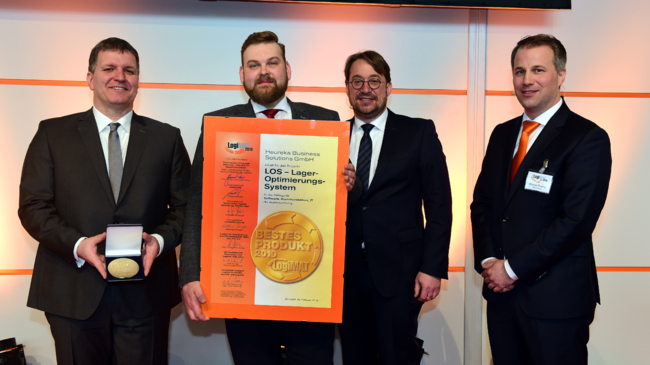
An add-on that makes warehouse management systems (WMS) even smarter. That's LOS from Heureka, the German startup that won one of the three innovation awards at LogiMAT. Heureka claims that throughput times in warehouses can be reduced by 30 per cent by using the tool. WMS vendors themselves are also working hard to optimise processes.
Among other things, the Lager-Optimierungs-Software (LOS) calculates how best to distribute the order lines among the order pickers to minimise the total walking distance. Such methods for calculating the shortest walking route have been around for years. They are also used in warehouse management systems, but almost always the same ones. "However, the world is constantly changing. The method that is optimal today may not work as well tomorrow. We recalculate the best walking route every time," explains Heureka director Raymond Hemmecke.
Predicting the future
In addition, LOS continuously calculates all process times. "We know how long it takes order pickers to walk from one picking location to another and pick an item. We use that data to predict the future," Hemmecke explains. He takes the packing process as an example. To keep employees working behind the packing tables, the inflow from the order picking area must be sufficiently large. "We know when the buffer runs out and alert the man in charge. The latter can then take timely action. Or as we say agitate instead of react."
LOS has already been implemented at Germany-based logistics service provider Loxxess. "We are now rolling out the system further across Loxxess' other sites," states Hemmecke, who points out that LOS can be linked to any warehouse management system. "Assortments are constantly changing and the number of exceptions to the rule is increasing. Order patterns also change from day to day, think of the ratio of large and small orders in omnichannel warehouses. LOS constantly analyses more than a hundred factors, which makes it possible to process goods flows as efficiently as possible at any time."
Optimal utilisation
Existing warehouse automation specialists are also putting time and money into artificial intelligence. One example is Knapp, which has invested in an Austrian startup called redPILOT. This startup has developed a tool for warehouse with different systems. The tool calculates how best to use those systems at any time of the day. It also continuously analyses the current utilisation, which can lead to proposals to change the utilisation of the different systems. "Compare it to a labour management system," says Werner De Swaef, sales director of Knapp in Benelux. "As a specialist in automated storage and order picking systems, we can also use this tool to increase the efficiency of manual processes."
SSI Schäfer showed an app for smartphones and tablets at LogiMAT. Warehouse managers and supervisors get real-time insight into performance indicators and goods flows via that app. This enables them to continuously adjust the operation, even when they themselves are elsewhere. The result according to SSI Schäfer: optimal use of the possibilities offered by the warehouse. And thus better performance.