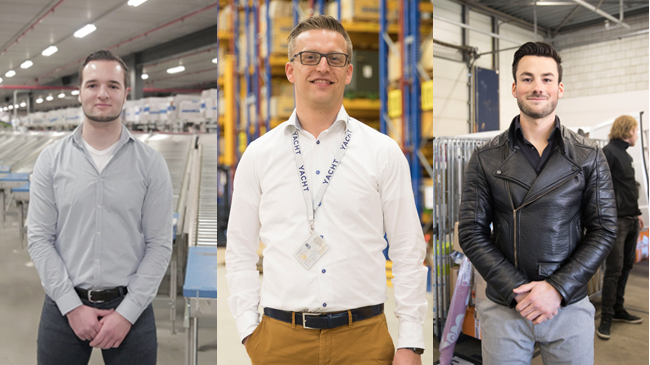
Three talents with three completely different achievements: Tijs van Driel leads start-up Red je Pakketje, Lennart Stachowitz was responsible as Logistics Engineer for bol.com's high-season preparations, and Jeroen Provoost implements improvement projects at Defence as interim manager. The logisticians have one thing in common: they have a chance to win the Young Logistics Talent title on 11 April. Who are these talents and why do they think they have a chance of winning the title?
Lennart Stachowitz - Project manager at Ingram Micro
 Lennart Stachowitz participated in the Young Logistics Talent election back in 2015. Then he came fifth, now he is among the last three nominees. And not without reason: already at 23, Stachowitz was responsible as Logistics Engineer at Ingram Micro for the high season preparations for bol.com.
From the warehouse of logistics service provider Ingram Micro in Waalwijk, Stachowitz and his colleagues start preparations for the following season in December. "We look at the forecast for the upcoming year and translate all those orders to the different processing areas," he says. Based on that analysis, the Logistics Engineer estimates in which processing areas there might be capacity shortages, for example. "From there, I set up projects to increase that capacity. This is a challenge because we don't have a production environment that we can shut down for a fortnight to roll out a project. In addition, we always look at solutions that are scalable. This can be done by setting up packing tables that you only man during a high season. Or by shifting the hours of operation." The Logistics Engineers work on the projects until October, after which it is transferred to operations.
The two peak seasons Stachowitz ran for bol.com were "very successful", according to the finalist. "Consumers are confident that ordering can be done later and later. The peak moments are therefore becoming more intense. Yet we have run incredibly good peak seasons in this building on Veerweg. There was no dire capacity surplus or shortage in departments."
23 seems young for such responsibilities, Stachowitz also acknowledges. "It is quite special to already develop a model at that age, on which management also bases its choices. But at Ingram Micro, they don't pay much attention to age. People trust you."
Since the beginning of this year, Stachowitz has been working as a project manager within the same department. "As an engineer, I also did a bit of project management. I felt the need to focus more on that. In my current role, I filter requests from engineers; what are we going to do and what are we not going to do? I like that very much. I have a coaching role and am strategically involved in this function. In this way, I also get to experience more of Ingram Micro's vision."
Why Stachowitz should win. "As an engineer, sometimes you work on 20 different projects at the same time. Sometimes you sit with internal stakeholders, other times with a supplier. One of my strengths is adapting myself to the person I have in front of me. With someone from the technical department you talk very differently from someone from IT. I have immersed myself in programming language so that I can read along with an IT person, for example. If you know how to address people, you create support."
Tijs van Driel - COO at Red je Pakketje
 Tijs van Driel took an unconventional path in his young career in logistics. He started the leaden training to become a marine officer after secondary school, but traded his uniform in 2016 for startup Save Your Package. There, he is co-owner and COO.
Red je Pakketje is a same-day delivery carrier. The company picks up orders from online shops until 14:30 and delivers them to consumers' homes in the evening. There is a maximum of 10 hours between pick-up and delivery time. Consumers receive a half-hour time slot and can change the delivery address at any time. "These are actually very simple things, which are not yet possible with many large parties," he says. That this is in high demand is evident from the exponential growth Red je Pakketje has experienced. Van Driel: "In the beginning, we used friends and acquaintances as drivers and worked with passenger cars and some smaller vans. That quickly changed." In eighteen months, the carrier grew to a company with 110 buses, more than 230 drivers and clients such as Greetz, BVA and Cameranu. Last year, the company recorded a volume growth of 750 per cent. It no longer operates from one location, but from seven hubs spread across the country.
It is up to Van Driel to manage that growth. He is responsible for the drivers and hub managers but also for planning, customer service, and fleet management. "Monitoring quality during growth is the biggest challenge for me. It has a lot of sides. First of all, you have to find a lot of people and keep training them properly. In addition, you have to adjust and scale up processes all the time." How do you do that without a logistics background? "I immerse myself in the Lean philosophy, but above all it's also a piece of common sense. For instance, the choice of local hubs. That does involve data, but we also just look at what is convenient. The Netherlands is a small country. Getting a parcel from a to b doesn't have to be very complicated. We want to keep it simple. And it helps that there are lots of good people working at Red je Pakketje, who work very hard together with me."
About the finals day, Van Driel says: "I guess it takes some getting used to. I don't normally step forward like this, but see it as a great opportunity to highlight what we have put in place and how I managed it logistically."
Jeroen Provoost - interim manager at Yacht/Defence

When Jeroen Provoost was seconded to Defence via Yacht, he saw quite a few challenges: isn't the organisation too unwieldy to change? And isn't Defence stuck in ranks and protocols? The opposite turned out to be true. "Yes there are protocols, grades and rules but as soon as a certain idea contributes to a better organisation, people get moving and steps can be taken."
Provoost studied Logistics & Technical Transport Engineering at the NHTV in Breda. After graduating, he was able to start work immediately at De Efteling, where his focus included optimising storage and transhipment and improving internal processes. He has since swapped the theme park for another organisation: Yacht.
From Yacht, Provoost was initially seconded to Defence for a year, at the Royal Air Force's Woensdrecht Logistics Centre. After a year, Provoost decided to extend his assignment and implement the improvement projects across Defence. "The first year I worked as asset manager at Mission Support Systems (MOS Green), now as interim manager at Programme Management. I do not get involved in the processes, but try to implement improvements: what are we doing, what is the result of it and what can be done differently? We work with the scrum methodology here. Every morning, we meet with participants and discuss the status. My biggest role in this is to bring people and departments together and discover common problems or bottlenecks. By looking for common problems and bottlenecks from different departments, and then jointly solving these bottlenecks, an incredibly strong organisation is created.
In June, Provoost's assignment at Defence expires. He leaves the organisation with peace of mind. "The improvement process is continuing. People know how to find each other. That's important as an interim: that when you leave things are boarded up and people take ownership of the process." What he will do next? "I don't know exactly yet, I find many different companies and markets interesting, changing organisations always provide challenges. Fortunately, Yacht supports me in this to develop and take on another new challenge."
When asked what makes Provoost a Young Logistics Talent, he does not have to think long: "Connecting people. What concerns me is translating the vision from senior management to the processes on the floor. And vice versa: translating the problems of the people on the floor into action points for management. The industry sometimes focuses too much on a KPI while if you turn one meter, something can change somewhere else. The story, the explanation of the meter and the overall plan is where the people come in. People make the organisation."











